
Stictoleptura canadensis
(Olivier, 1795)
Red-shouldered Pine Borer
Species Guides
3Stictoleptura canadensis, commonly known as the red-shouldered pine borer, is a longhorn beetle in the Cerambycidae. The occurs in Canada and the United States. Larvae develop in dead or decaying wood, while feed on flowers. The refers to a distinctive red coloration on the shoulder region.
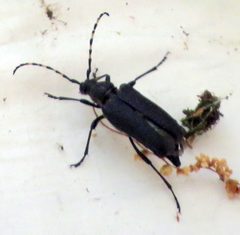
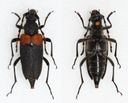
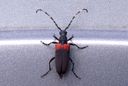
Pronunciation
How to pronounce Stictoleptura canadensis: /stɪk.toʊˈlɛp.tjʊ.rə ˌkæn.əˈdɛn.sɪs/
These audio files are automatically generated. While they are not always 100% accurate, they are a good starting point.
Images
Habitat
Larvae inhabit dead or decaying wood, sometimes utilizing living plants as . They move through soil, feeding on roots or tunneling beneath the root crown. are found in areas where their larval host plants occur and where flowering vegetation is available.
Distribution
Canada and the United States. GBIF records indicate presence in Canada (CA) and the United States (US), including Vermont.
Diet
Larvae feed on dead or decaying wood, and have been observed feeding on roots and tunneling under root crowns. feed on flowers; individual adults show variation in feeding preferences including sap, bark, leaves, blossoms, fruits, or fungi.
Host Associations
- Pinus - larval implied by
Life Cycle
In temperate climates, the larval stage lasts 1–3 years, though cycles of 2–3 months to several decades have been recorded. emerge, disperse, reproduce, and die within a period ranging from 3 days to several months.
Behavior
Larvae are mobile in soil. are flower visitors that disperse following . Girdler larvae cut living branches or twigs.
Ecological Role
Larvae contribute to wood decomposition and nutrient cycling. may serve as when visiting flowers.
Similar Taxa
- Anelaphus spp.Both are longhorn beetles (Cerambycidae) whose larvae develop in woody plants; Anelaphus are twig pruners that cut branches internally before , whereas Stictoleptura canadensis larvae feed on dead/decaying wood and roots.
More Details
Taxonomic note
The was originally described as Anoplodera canadensis by Olivier in 1795 (or 1800 in some sources). It has been transferred to the Stictoleptura.