
Stictoleptura
Casey, 1924
Species Guides
1- Stictoleptura canadensis(Red-shouldered Pine Borer)
Stictoleptura is a of longhorn beetles (Cerambycidae) distributed across the Holarctic region, with in Europe, Asia, and North America. The genus includes medium-sized beetles typically associated with broadleaved woodland . The first sequence for the genus was published for Stictoleptura scutellata, a scarce species in Britain associated with ancient woodland and wood pasture.
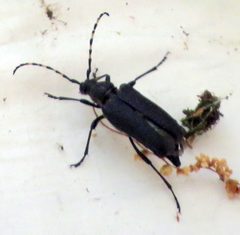
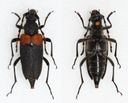
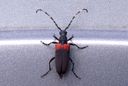
Pronunciation
How to pronounce Stictoleptura: /ˌstɪktoʊˈlɛptʊrə/
These audio files are automatically generated. While they are not always 100% accurate, they are a good starting point.
Images
Habitat
in this are associated with broadleaved woodland, wood pasture, and deciduous forest . Stictoleptura scutellata specifically inhabits ancient broadleaved woodland and wood pasture, with a preference for beech forest and other deciduous woodland types. North American species have been recorded in juniper/oak/pinyon woodland and similar montane forest habitats.
Distribution
Holarctic distribution spanning western Palaearctic and Nearctic regions. European records concentrated in France, Sweden, United Kingdom, Germany, Austria, and the Netherlands, with scattered records from Asia and North Africa. In Britain, the is scarce with in the New Forest, North Downs, and Epping Forest areas. North American records include the southwestern United States (New Mexico) and Vermont.
Seasonality
active from late spring through late summer, with records spanning May to September. Activity period varies by and latitude.
Diet
Larvae are on broadleaved , feeding in dead wood of moderate to large diameter. Documented host trees include Fagus sylvatica (beech), Carpinus (hornbeam), Quercus (oak), Alnus (alder), Betula (birch), Corylus avellana (hazel), Fraxinus (ash), Castanea (chestnut), and Populus (poplar). have been observed visiting flowers including hawthorn and bramble.
Host Associations
- Fagus sylvatica - larval dead wood of moderate to large diameter
- Carpinus - larval dead wood
- Quercus - larval dead wood
- Alnus - larval dead wood
- Betula - larval dead wood
- Corylus avellana - larval dead wood
- Fraxinus - larval dead wood
- Castanea - larval dead wood
- Populus - larval dead wood
Life Cycle
Prolonged typically lasting 2–3 years, with some observations extending to 4 years. Larvae develop within dead wood of trees; occurs in the wood. emerge and are active during the warmer months.
Behavior
are known to visit flowers, particularly hawthorn and bramble blossoms. One , Stictoleptura scutellata, has a partially yellow scutellum that aids in field recognition.
Ecological Role
Saproxylic that contributes to wood decomposition processes in deciduous forests. Larval development in dead wood links the to decaying wood networks in broadleaved woodland .
Human Relevance
Subject of genomic research through the Darwin Tree of Life project. Stictoleptura scutellata represents the first -level assembly for the , with potential applications in understanding cerambycid beetle and forest dynamics.
More Details
Genomic resources
Stictoleptura scutellata assembly: haploid size ~1.48 Gb, heterozygosity 0.98%, repeat content 39.25%. Assembly contains 10 (9 + X ). Mitochondrial genome 17.97 kb. Specimen from Catfield Fen, England.
Research methods
Specimens have been collected using sweet red wine-baited jug traps and ethanol-baited traps in woodland , indicating attraction to fermentation cues.