
Dorcaschema alternatum
(Say, 1824)
Small Mulberry Borer
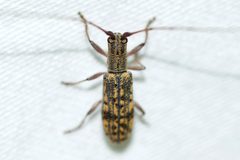
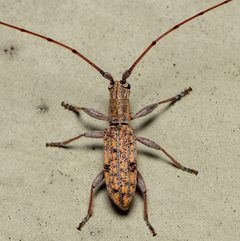
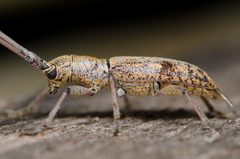
Dorcaschema alternatum is a cerambycid beetle native to North America, commonly known as the Small Mulberry Borer. It was first described by Thomas Say in 1824, originally placed in the Saperda. The is strongly associated with mulberry trees, specifically Celtis-leaf mulberry (Morus celtidifolia), which serves as its larval . It is widely recorded across the United States and southern Canada.
Pronunciation
How to pronounce Dorcaschema alternatum: /dɔrkaˈskiːmæ aːltɛrˈnaːtʊm/
These audio files are automatically generated. While they are not always 100% accurate, they are a good starting point.
Identification
Can be distinguished from other Dorcaschema by the alternating pattern of light and dark markings on the , which gives the species its name. The Dorcaschema is characterized by a somewhat flattened body form and relatively short compared to many longhorn beetles. Separation from the closely related D. wildii requires examination of antennal segment proportions and elytral pattern details.
Images
Habitat
Associated with wooded areas and urban plantings where trees occur. Larvae develop within the wood of living or recently dead mulberry trees.
Distribution
Recorded from the United States, southern Canada (Ontario), and Mexico. Distribution corresponds closely with the range of its plant Morus celtidifolia in North America.
Diet
Larvae feed on the wood of Morus celtidifolia (Celtis-leaf mulberry, Texas mulberry). likely feed on bark, leaves, or other plant tissues, though specific adult diet is not documented.
Host Associations
- Morus celtidifolia - larval Primary and apparently obligate ; larvae bore into trunk and branches
Behavior
Larvae are wood-borers, tunneling under the bark and into the heartwood of trees. This can weaken or kill branches and occasionally entire trees.
Ecological Role
As a primary wood-borer in mulberry trees, contributes to nutrient cycling through the breakdown of woody tissue. May act as a control mechanism for mulberry in native .
Human Relevance
Considered a minor pest of ornamental mulberry trees and potentially of economic concern in areas where mulberry is cultivated for fruit or rearing. The "Small Mulberry Borer" reflects its association with this .
Similar Taxa
- Dorcaschema wildiiOverlapping range and similar size; distinguished by antennal proportions and elytral pattern details
- Saperda speciesOriginal description placed D. alternatum in this ; Saperda generally have longer relative to body and different associations (typically Salix, Populus, or Corylus)
More Details
Taxonomic History
First described as Saperda alternata by Thomas Say in 1824, later transferred to Dorcaschema. The original epithet alternata was adjusted to alternatum to match the neuter gender of Dorcaschema.