
Dorcaschematini
Genus Guides
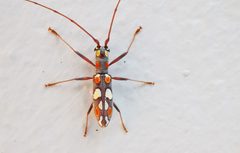
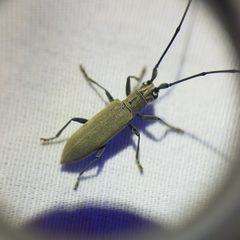
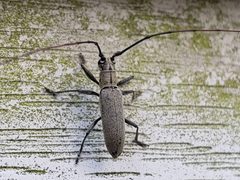
1Dorcaschematini is a tribe of longhorn beetles (Cerambycidae: Lamiinae) distributed across tropical South China, Southeast Asia, and Oceania. Members are distinguished by highly punctate, tomentose covered with recumbent hairs, bulbous and coarsely granulated antennal scape, and elongated third antennomere. The tribe contains at least nine including Cylindrepomus, Olenecamptus, and Dorcaschema. Several have been introduced to Europe through ornamental plant trade.
Pronunciation
How to pronounce Dorcaschematini: //dɔr.kæsˈkɛ.məˌtiː.naɪ//
These audio files are automatically generated. While they are not always 100% accurate, they are a good starting point.
Identification
Distinguished from other Lamiinae tribes by the combination of: highly punctate and tomentose with recumbent hairs; bulbous, coarsely granulated antennal scape; and third antennomere two to four times longer than the scape. These features are consistent across examined including Cylindrepomus and Olenecamptus.
Images
Habitat
Old-growth secondary forest with high moisture and semi-open foliage; riparian areas at 600–1100 m elevation; urban areas near plant nurseries and transport infrastructure for introduced .
Distribution
Native range: tropical South China, Southeast Asia, and Oceania including the Philippines, Andaman Islands, and Madagascar. Introduced range: Europe (first records 2023 from Spain and Greece).
Diet
Larvae bore into sapwood and hardwood of live plants or recently dead humid wood. feed on green bark of shoots and chew large leaves.
Host Associations
- Ficus hederacea - probable observed with large numbers of Cylindrepomus filiformis in Andamans
- Arthrocarpus - preferred for Olenecamptus bilobus
- Ficus - preferred for Olenecamptus bilobus
- Morus - preferred for Olenecamptus bilobus
Life Cycle
Larvae bore into sapwood in early instars, subsequently penetrate hardwood; develops primarily on live plants or recently dead humid wood.
Behavior
attracted to light; can be collected at light traps. Olenecamptus bilobus responds to multi-lure blends of and volatiles in native environment.
Ecological Role
Wood-boring beetles; modest phytosanitary concern in native range.
Human Relevance
Olenecamptus bilobus introduced to Europe via ornamental plant trade; considered potential phytosanitary risk. Specimens killed with ethyl acetate for preservation in scientific collections.
Similar Taxa
- Other Lamiinae tribesDorcaschematini distinguished by unique antennal : bulbous granulated scape and elongated third antennomere, combined with tomentose, punctate .
Sources and further reading
- BugGuide
- Wikipedia
- iNaturalist taxon
- NCBI Taxonomy
- Catalogue of Life
- Rediscovery of Cylindrepomus filiformis Breuning, 1938 (Cerambycidae: Lamiinae: Dorcaschematini) from the Andaman Islands, India
- Catalog of the genus Cylindrepomus Blanchard (Coleoptera, Cerambycidae, Dorcaschematini) in the Philippines, with description of a new species from northern Mindanao
- Simultaneous detections of Olenecamptusbilobus (Fabricius, 1801) (Cerambycidae, Dorcaschematini) in Europe.