
Tigrinestola
Breuning, 1949
Species Guides
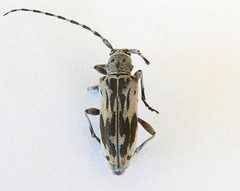
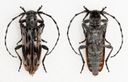
1Tigrinestola is a of longhorn beetles ( Cerambycidae) in the Lamiinae, tribe Desmiphorini. It was established by Breuning in 1949 and contains two described : T. howdeni and T. tigrina. The genus is known from the southwestern United States and Mexico. Tigrinestola tigrina has been documented from oak woodlands in southeastern Arizona, where it has been collected at light and by beating dead oak branches.
Pronunciation
How to pronounce Tigrinestola: //ˌtaɪɡrɪˈnɛstələ//
These audio files are automatically generated. While they are not always 100% accurate, they are a good starting point.
Identification
Tigrinestola belongs to the tribe Desmiphorini, characterized by relatively slender, elongate bodies and often muted coloration. The name references tiger-like (tigrine) markings, suggesting patterned . T. tigrina can be distinguished from T. howdeni by differences in size and elytral pattern; T. tigrina exhibits more pronounced dark transverse bands on a lighter background. Within Desmiphorini, Tigrinestola is distinguished from related genera by specific combinations of antennal length, pronotal shape, and elytral , though precise diagnostic features require examination of .
Images
Habitat
Tigrinestola tigrina has been collected in oak/juniper woodland and riparian oak . Specimens have been taken by beating dead branches of Quercus hypoleucoides (silverleaf oak) and at mercury-vapor/ultraviolet light stations in montane canyon environments. The appears associated with oak-dominated in the Madrean Sky Islands region.
Distribution
The occurs in the southwestern United States and Mexico. T. howdeni is known from Mexico. T. tigrina has been documented from southeastern Arizona (Huachuca Mountains, Santa Rita Mountains) and presumably ranges into adjacent Mexico.
Seasonality
Tigrinestola tigrina has been collected in late July in southeastern Arizona. Activity likely coincides with the summer monsoon season in the region.
Host Associations
- Quercus hypoleucoides - larval inferred collected by beating dead branches
Behavior
of T. tigrina have been observed at light stations, indicating activity. The has also been collected by beating dead oak branches, suggesting adults may shelter in or feed on dead wood material.
Ecological Role
As a member of the Cerambycidae, larvae likely function as wood-borers in dead oak branches, contributing to nutrient cycling in oak woodland .
Similar Taxa
- Other Desmiphorini generaTigrinestola shares the general slender body form and antennal characteristics of Desmiphorini; differentiation requires examination of pronotal and elytral details.
- SternidiusSternidius are also common in oak and similar in size; they differ in antennal segment proportions and elytral punctation patterns.
More Details
Taxonomic history
Tigrinestola tigrina was originally described as Saperda tigrina by Skinner in 1905, later transferred to Tigrinestola by Breuning. T. howdeni was described by Chemsak & Linsley in 1966.
Collection methods
Based on field observations, successful collecting methods include beating dead oak branches and ultraviolet/mercury-vapor light stations in appropriate and season.