
Desmiphora hirticollis
(Olivier, 1795)
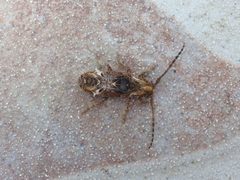
A longhorned beetle (Cerambycidae) in the Lamiinae, characterized by dense tufts of erect hairs that provide remarkable against tree bark. are strictly and hide on the undersides of freshly cut logs during daylight hours. The occurs from southern Texas through South America, with documented associations with trees in the Boraginaceae as larval .
Pronunciation
How to pronounce Desmiphora hirticollis: //dɛzˈmɪfɔːrɑː ˌhɜːtɪˈkɒlɪs//
These audio files are automatically generated. While they are not always 100% accurate, they are a good starting point.
Identification
Recognizable by the -level trait of fasciculate tufts (pencils) of erect or suberect hairs on the body. Specifically identified by ( brownish-black) and small black pencils positioned just before the elytral apices. The hair tufts break up the body outline, making nearly invisible against bark when viewed from above.
Images
Habitat
Found in forested areas, particularly in association with freshly cut wood piles and logs. In Argentina, observed in Selva Paranaense (Paraná forest) . specifically encountered on cut logs of guayaibi (Patagonula americana, Boraginaceae).
Distribution
Southern Texas (north to Corpus Christi) south through Mexico, Central America, and South America to Bolivia and Argentina. Also recorded from the Galapagos Islands, Puerto Rico, Jamaica, and the Caribbean.
Host Associations
- Patagonula americana - LARVAL_HOSTAll observed in Corrientes, Argentina were found on cut logs of this , suggesting it serves as larval .
- Cordia spp. - LARVAL_HOST frequently collected on this in Texas; adults reared from Cordia eleagnoides.
- Ehretia anacua - LARVAL_HOST collected on this in Texas.
- Sapium sp. - LARVAL_HOSTLarvae described from specimens collected from this .
Life Cycle
Larvae develop as wood-borers in trees. emerge and are attracted to freshly cut wood piles, where they hide on undersides of logs during daylight.
Behavior
Strictly ; hide motionless on undersides of logs during the day. When disturbed, remain motionless, relying on for defense.
Ecological Role
Wood-boring whose larvae develop in living or recently dead hardwood trees. contribute to nutrient cycling through association with decaying wood.
Similar Taxa
- Desmiphora fasciculataAlso possesses dense hair tufts and has been suggested to mimic hairy caterpillars; however, D. fasciculata is and found on foliage rather than strictly and bark-dwelling.
Sources and further reading
- BugGuide
- Wikipedia
- GBIF taxonomy match
- iNaturalist taxon
- NCBI Taxonomy
- Catalogue of Life
- Desmiphora hirticollis: Crypsis or Mimicry? | Beetles In The Bush
- Cosmetid harvestman with parasitic/phoretic mites in Argentina | Beetles In The Bush
- Maddening mutillid | Beetles In The Bush
- Mutillidae | Beetles In The Bush