
Purpuricenus humeralis
(Fabricius, 1798)
Red Triangle Long-horned Beetle
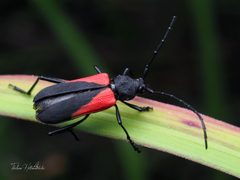
Purpuricenus humeralis is a large, showy longhorn beetle in the Cerambycidae, first described by Fabricius in 1798. It is distinguished from by triangular red or orange markings on the humeri (shoulders) of the , rather than transverse bands covering the basal half. The occurs in northeastern North America and is attracted to fermenting traps. It is one of three similar Purpuricenus species in eastern North America, historically confused with P. axillaris until careful study revealed consistent morphological differences.
Pronunciation
How to pronounce Purpuricenus humeralis: //pɜːrˈpjʊərɪsiːnəs hjuːməˈreɪlɪs//
These audio files are automatically generated. While they are not always 100% accurate, they are a good starting point.
Identification
Distinguished from P. axillaris by triangular (not transverse) basal elytral markings that cover only the humeri rather than the basal half of the , and by the margin of the markings being oblique rather than more or less transverse. Differs from P. paraxillaris by weaker pronotal calluses without polished line on the callus, smaller lateral pronotal with obtuse (not acute) angles, finer and sparser basal elytral punctation, and subtruncate (not ) elytral apices without distinctly dentate angles. The elytral markings in P. humeralis are typically more reddish than the yellow-orange of P. axillaris.
Images
Appearance
Large, robust cerambycid beetle with velvety black . Basal elytral markings are distinctly triangular, covering only the humeri (shoulders), colored vivid red to orange-red. margin of these markings is oblique, with the dark area extending forward along the to reach the scutellum. Pronotum with weak discal calluses; callus lacks a polished apical line. Lateral pronotal are small with obtuse angles. Elytral apices are subtruncate, with angles not distinctly dentate. Basal elytral punctation is relatively fine and sparse compared to . are long, extending beyond the body in males.
Habitat
Associated with forested , particularly oak woodlands. The has been collected in dry post oak woodland, xeric sand prairie remnants with oaks, and mesic lowland deciduous forest. are attracted to fermenting traps placed in these environments. Larval likely include oak species (Quercus), based on habitat associations and comparison with related species.
Distribution
Northeastern North America, ranging from Canada (Manitoba, New Brunswick, Ontario, Québec) south and west to Oklahoma. Not currently recorded from Texas. The occurs in the central and eastern United States, with collection records from Missouri, Illinois, and surrounding states.
Seasonality
are active in summer, with collection records from mid-June through July. Peak activity appears to coincide with warm summer conditions. Attraction to fermenting traps suggests adults may be seeking food sources or oviposition sites during this period.
Host Associations
- Quercus - probable larval Based on associations in oak woodlands and comparison with ; specific records not documented in available sources
Behavior
are attracted to fermenting traps containing mixtures such as molasses, beer, yeast, and water. They are primarily or in their attraction to baits. The appears to be a strong flier capable of locating bait sources from distance. Adults do not feed on wood; larvae are the wood-boring stage.
Ecological Role
As larvae, likely function as wood-borers in oak and possibly other hardwood , contributing to nutrient cycling in forest . The specific ecological role is not well documented but is inferred from related species and characteristics.
Human Relevance
Of interest to coleopterists and naturalists due to its large size and striking coloration. The was historically sought after by collectors using fermenting traps, contributing to early documentation of its distribution. Not known to be an economic pest.
Similar Taxa
- Purpuricenus axillarisSimilar size and coloration, but distinguished by transverse (not triangular) basal elytral markings covering the basal half of , yellow to orange (not red) markings, and weaker pronotal features
- Purpuricenus paraxillarisSimilar appearance but distinguished by more robust build, prominent pronotal calluses with polished line, acute lateral pronotal , coarser elytral punctation, and elytral apices with dentate angles
- Purpuricenus linsleyiOccurs in Texas hill country and can be confused with P. humeralis, but has different elytral marking shape and is geographically separated
More Details
Discovery and Taxonomic History
This was among the first two Purpuricenus species documented in eastern North America, described by Fabricius in 1798. For many years it was confused with P. axillaris, which was described later in 1847. The two species were not consistently distinguished until detailed morphological studies by MacRae (2000) clarified their separation, along with the description of the new species P. paraxillaris. The key diagnostic feature—the triangular versus transverse elytral markings—was noted by early authors but not consistently applied.
Collection Methods
P. humeralis is readily collected using fermenting traps, a technique first described for this by Champlain and Knull in 1932. The standard bait mixture of molasses, beer, yeast, and water placed in bucket traps has proven highly effective for this and related Purpuricenus . This method has been instrumental in documenting the true distribution and abundance of the species, which was historically considered rare due to its cryptic habits.