
Purpuricenus axillaris
Haldeman, 1847
White Oak Branch Girdler
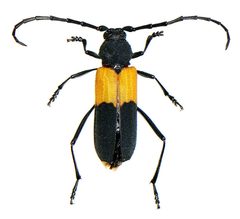
Purpuricenus axillaris is a large, showy longhorned beetle in the Cerambycidae, described by Haldeman in 1847. It is one of three eastern North American in the Purpuricenus, distinguished by transverse basal elytral markings that cover the entire basal half of the in yellow to orange coloration. The species is strongly attracted to fermenting traps and has been documented in association with hickory (Carya) as its larval . It was historically confused with the similar but distinct P. paraxillaris, which was described as a new species in 2000.
Pronunciation
How to pronounce Purpuricenus axillaris: //pɜːrpjʊˈraɪsənəs əɡˈzɪləˌrɪs//
These audio files are automatically generated. While they are not always 100% accurate, they are a good starting point.
Identification
Distinguished from P. humeralis by transverse (not triangular) basal elytral markings that do not extend only to humeri, and by dark area not extending forward along to scutellum. Separated from the very similar P. paraxillaris by smaller more gracile body, weaker pronotal lacking polished apical line on callus, obtuse rather than acute lateral pronotal angles, finer sparser basal elytral punctation, subtruncate rather than elytral apices without distinct teeth, and yellow to orange rather than orange to red-orange elytral markings.
Images
Appearance
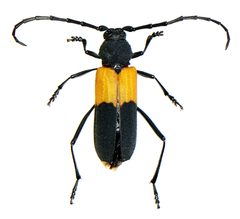
Large, robust cerambycid beetle with velvety black bearing vivid yellow to orange transverse markings covering the basal half of each elytron. margin of basal markings is more or less transverse, not oblique. Pronotum with weak discal calluses; callus lacks a polished line. Lateral pronotal are small with obtuse angles. Basal elytral punctation relatively fine and sparse. Elytral apices subtruncate, angles not distinctly dentate. Smaller and more gracile than the similar P. paraxillaris.
Habitat
Associated with dry, post oak woodlands and interfaces between woodland and glade . have been collected in fermenting traps placed along upwind edges between dry post oak woodland and dolomite glades.
Distribution
Eastern North America; recorded from Ontario, Canada and United States. Historical literature records may include misidentifications with P. paraxillaris.
Seasonality
active from early June through mid-September based on trap collections in Missouri. Peak activity period not precisely determined.
Diet
Larvae feed on hickory (Carya ). feeding habits not documented.
Host Associations
- Carya - larval Preferred larval ; based on reared specimens
Life Cycle
Complete with wood-boring larval stage in hickory. Specific details of laying, larval development duration, , and longevity not documented.
Behavior
Strongly attracted to fermenting baits including molasses/beer mixtures and red wine. Readily falls into open-top buckets rather than perching on trap surfaces. habits inferred from related but not directly confirmed.
Ecological Role
Wood-boring whose larvae develop in living or recently dead hickory trees. Role in nutrient cycling through dead wood decomposition. Specific ecological interactions not documented.
Human Relevance
Collected by entomologists using fermenting traps for survey and study. No documented economic importance as pest or beneficial . Subject of taxonomic study that helped clarify species boundaries in the .
Similar Taxa
- Purpuricenus paraxillarisVery similar sympatric distinguished by larger more robust body, stronger pronotal with polished line on callus, acute lateral pronotal angles, coarser denser basal elytral punctation, elytral apices with distinct teeth, and orange to red-orange elytral markings. Uses oak and chestnut rather than hickory as larval .
- Purpuricenus humeralisDistinguished by triangular basal elytral markings covering only humeri rather than entire basal half, and dark area extending forward along to scutellum.
Misconceptions
Historically confused with P. paraxillaris, with many literature references to P. axillaris actually referring to the undescribed species. The two were not recognized as distinct until 2000, after examination of large series from trapping revealed consistent morphological differences.
More Details
Taxonomic history
Type series at Museum of Comparative Zoology, Harvard University, was found to contain both P. axillaris and the undescribed P. paraxillaris, requiring designation of a lectotype to fix the name.
Bait trap attraction
Documented from fermenting traps with both molasses/beer and red wine baits. In 2015 Missouri study, 3 specimens collected: 2 from molasses/beer, 1 from red wine, compared to 20 specimens of the more abundant P. paraxillaris at same sites.