
Purpuricenus
Dejean, 1821
Purplescent Longhorn Beetles
Species Guides
6- Purpuricenus axillaris(White Oak Branch Girdler)
- Purpuricenus dimidiatus(Scrub Oak Borer)
- Purpuricenus humeralis(Red Triangle Long-horned Beetle)
- Purpuricenus linsleyi
- Purpuricenus opacus
- Purpuricenus paraxillaris(White Oak Branch Girdler)
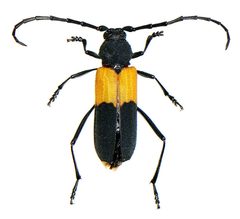
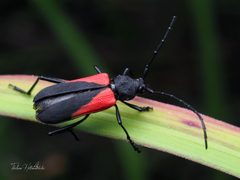
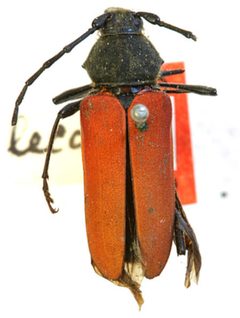
Purpuricenus is a of longhorn beetles (Cerambycidae) comprising approximately 50 distributed across the Northern Hemisphere. North American species are large, showy beetles with velvety black bodies and vivid red or orange basal elytral markings. The genus has been extensively studied due to its attractiveness to fermenting traps, a collecting method that has revealed cryptic and clarified associations. The 2000 revision by MacRae resolved taxonomic confusion in eastern North America by distinguishing P. paraxillaris from the similar P. axillaris based on morphological and ecological differences.
Pronunciation
How to pronounce Purpuricenus: /pʊrpəˈraɪsənəs/
These audio files are automatically generated. While they are not always 100% accurate, they are a good starting point.
Identification
Eastern North American are distinguished by the shape and extent of basal elytral markings and pronotal development. P. humeralis has triangular basal markings covering only the humeri with margins distinctly oblique and dark area extending forward along the to the scutellum. P. axillaris has transverse basal markings covering the basal half of , weak pronotal discal calluses without polished apical line, small lateral pronotal tubercles with obtuse angles, finer basal elytral punctation, and yellow to orange markings. P. paraxillaris resembles P. axillaris but is larger and more robust with distinct pronotal discal calluses bearing a polished apical line on the callus, well-developed lateral pronotal tubercles with acute angles, coarser and denser basal elytral punctation, elytral apices with distinctly dentate angles, and orange to red-orange markings.
Images
Habitat
In North America, occur at the interface between dry woodlands and open such as glades. In the Mediterranean region of southern France, P. globulicollis is restricted to the Quercus pubescens zone. are associated with tree in sunniest locations.
Distribution
Holarctic distribution with in North America, Europe, and Asia. In North America: P. humeralis ranges from the Northeast to Oklahoma; P. axillaris and P. paraxillaris occur across the eastern United States; P. linsleyi is known from Texas. In Europe: P. kaehleri, P. budensis, and P. globulicollis occur in southern France with P. globulicollis restricted to the Mediterranean zone.
Seasonality
activity peaks in summer. In Missouri, fermenting traps were most productive from early June to mid-September.
Host Associations
- Carya - larval P. axillaris
- Quercus - larval P. paraxillaris
- Castanea - larval P. paraxillaris
- Quercus pubescens - probable larval P. globulicollis (suggested but not confirmed)
Behavior
are . Strongly attracted to fermenting baits including molasses-beer mixtures and red wine. In trapping studies, P. paraxillaris showed significantly greater attraction to red wine than to molasses-beer, while P. axillaris showed the opposite pattern. Adults are rarely encountered directly on trees despite their large, conspicuous appearance.
Human Relevance
Subject of taxonomic research due to historical confusion between similar . P. paraxillaris was described as new in 2000 based on specimens initially collected in 1984, demonstrating the value of extensive series from trapping for resolving cryptic diversity. Fermenting bait trapping for this has been documented since the 1920s and remains a standard collecting technique for Cerambycidae.
Similar Taxa
- P. axillaris vs. P. paraxillarisHistorically confused; distinguished by size, pronotal development, elytral punctation , elytral apex shape, and marking color (orange vs. red-orange), as well as preference (hickory vs. oak/chestnut)
- P. humeralis vs. P. linsleyiCan be confused in Texas; P. linsleyi has transverse rather than triangular basal elytral markings
More Details
Fermenting Bait Trapping
The most effective documented recipe combines one part dark molasses, one part beer, and nine parts water with dry active yeast to initiate fermentation. Traps should contain 500–750 mL minimum volume and be placed at level in sunny locations. Open-top buckets are preferred over window jugs to reduce escape.
Taxonomic History
MacRae's 2000 revision of North American Purpuricenus was prompted by detection of consistent morphological differences within specimens identified as P. axillaris. Examination of type material at Harvard University's Museum of Comparative Zoology revealed both had been present in the original type series, requiring lectotype designation to fix the name P. axillaris to the smaller, more gracile form.