
Aethecerinus
Fall & Cockerell, 1907
Species Guides
3- Aethecerinus hornii(Horn's Aethecerinus Long-Horned Beetle)
- Aethecerinus latecinctus
- Aethecerinus wilsonii
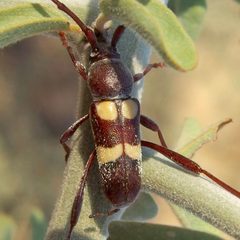
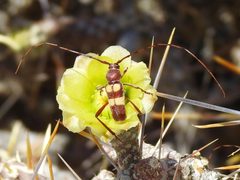
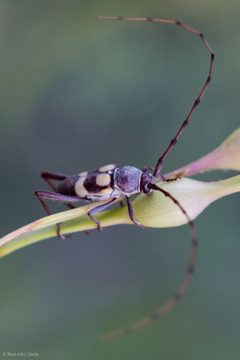
Aethecerinus is a of longhorned beetles in the Cerambycidae, established by Fall and Cockerell in 1907. The genus contains three described : Aethecerinus hornii, Aethecerinus latecinctus, and Aethecerinus wilsonii. Members of this genus belong to the tribe Trachyderini, a group known for bright coloration, activity, and attraction to flowers. Aethecerinus latecinctus has been documented feeding on mesquite flowers and is considered uncommon to rare in collections.
Pronunciation
How to pronounce Aethecerinus: //ˌaɪ.θəˈkɛ.rɪ.nəs//
These audio files are automatically generated. While they are not always 100% accurate, they are a good starting point.
Identification
Aethecerinus can be distinguished from other Trachyderini by their specific elytral color patterns and antennal . Aethecerinus latecinctus is characterized by a dark body with pale, laterally expanded bands on the . Accurate identification to species level requires examination of detailed morphological characters and comparison with .
Images
Habitat
Aethecerinus are associated with woody vegetation in arid and semi-arid regions. Aethecerinus latecinctus has been collected on mesquite (Prosopis glandulosa) in mesquite/saltbush chaparral and sand dune . The appears to utilize leguminous trees as food sources.
Distribution
The occurs in southwestern North America. Aethecerinus latecinctus ranges from Texas west to California and south into northern Mexico. Aethecerinus wilsonii has been recorded from northwestern Oklahoma, representing a northeastern range extension. Aethecerinus hornii was described from material collected in 1869, with subsequent records from the southwestern United States.
Seasonality
activity appears to be bimodal, with records from spring through early summer (May–June) and again in fall. Aethecerinus latecinctus has been collected in May in New Mexico and in June in Texas. Aethecerinus wilsonii was captured in jug traps in July in Oklahoma, suggesting possible summer activity.
Diet
have been observed feeding on flowers of mesquite (Prosopis glandulosa). Larval are presumed to be woody plants, likely leguminous trees, but specific host relationships remain undocumented.
Host Associations
- Prosopis glandulosa - food plant observed feeding on flowers
Behavior
are and have been observed flying to and feeding on blooming mesquite trees. They are attracted to flowers in bright daylight conditions and have been captured in by collectors using aerial nets.
Ecological Role
As flower visitors, likely contribute to pollination of mesquite and potentially other leguminous trees. Larvae presumably function as wood decomposers, though this has not been documented.
Human Relevance
Aethecerinus are of interest to coleopterists due to their rarity in collections and attractive appearance. No economic importance has been documented; they are neither agricultural pests nor biocontrol agents.
Similar Taxa
- Plionoma suturalisBoth belong to tribe Trachyderini, share similar body form, and occur on mesquite flowers. Plionoma suturalis has more extensive pale markings on the and a different antennal structure.
- Batyle suturalisOverlaps in and flower-visiting on mesquite, but Batyle suturalis has a more uniformly colored, reddish-orange body without the distinct pale lateral bands of Aethecerinus latecinctus.
More Details
Taxonomic history
The was established by Fall and Cockerell in 1907, with Aethecerinus hornii (originally described as Aethecerus hornii by Lacordaire in 1869) designated as the type . The genus has remained small, with only three species recognized.
Collection records
Aethecerinus are infrequently encountered in collections. Aethecerinus latecinctus has been recorded from El Paso County, Texas; Chaves County, New Mexico; and Hudspeth County, Texas. Aethecerinus wilsonii was captured in jug traps in Major County, Oklahoma in July 2023, representing a significant range extension.