
Opsimus quadrilineatus
Mannerheim, 1843
Opsimus quadrilineatus is a longhorn beetle and the sole in the Opsimus. It was described in 1843 and is native to western North America. The species belongs to the tribe Opsimini within the Cerambycinae. It is recognized by the four longitudinal stripes on its that give the species its name.
Pronunciation
How to pronounce Opsimus quadrilineatus: /ˈɒpsɪməs ˌkwɒdrɪˌlɪniˈeɪtəs/
These audio files are automatically generated. While they are not always 100% accurate, they are a good starting point.
Identification
Distinguished from other western North American cerambycids by the combination of four clean longitudinal stripes on the and placement in the tribe Opsimini. The Opsimus is , so -level identification within the genus is automatic. May be confused with striped species in other genera such as certain Elaphidion or Saperda, but these differ in antennal proportions, body shape, or stripe pattern (often more irregular or fewer stripes).
Images
Appearance
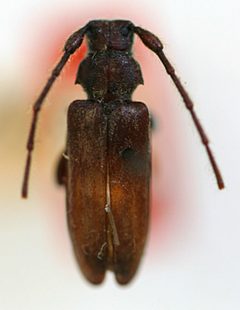
Medium-sized longhorn beetle with elongated body form typical of Cerambycinae. The bear four distinct longitudinal dark stripes (two per elytron) against a lighter background, accounting for the specific epithet "quadrilineatus" (four-lined). are moderately long, extending beyond the body but not dramatically so. Body coloration is generally pale with contrasting dark striping.
Habitat
Found in forested and woodland areas of western North America. Associated with coniferous and mixed forests where larval occur. Specific microhabitat preferences are poorly documented but likely include areas with standing or fallen woody debris suitable for larval development.
Distribution
Western North America. Documented from the Canadian provinces of Alberta and British Columbia, with records extending into the western United States. The distribution corresponds to the montane and forest zones of the Rocky Mountains and adjacent regions.
Seasonality
activity period is not well documented in published sources. Based on limited collection records and general patterns for related cerambycines, adults are likely active during the warmer months, roughly May through August.
Life Cycle
Complete with , larva, pupa, and stages. Larvae are wood-borers, developing within the stems or branches of plants. Specific host plant records are not well documented in available literature. likely occurs within the wood, with adults emerging through exit holes.
Ecological Role
As a wood-boring , larvae contribute to the decomposition of woody material and nutrient cycling in forest . May serve as a food source for woodpeckers and other that excavate beetle larvae from wood.
Human Relevance
No documented economic importance. Not known to be a pest of timber or ornamental trees. Occasionally encountered by collectors and naturalists in western North American forests.
Similar Taxa
- Saperda speciesSome Saperda have longitudinal elytral stripes, but these are in the Lamiinae (flat-faced longhorns) with different antennal insertions and generally more robust bodies.
- Elaphidion speciesCertain striped Elaphidion occur in overlapping ranges, but differ in antennal structure and usually have more irregular or broken markings rather than clean longitudinal stripes.
More Details
Taxonomic uniqueness
Opsimus quadrilineatus is the only in its , making it phylogenetically isolated among New World cerambycids. The tribe Opsimini is small and its members share reduced or modified mouthpart structures compared to other cerambycines.
Etymology
The specific epithet quadrilineatus refers directly to the four longitudinal stripes on the : Latin 'quadri-' (four) + 'lineatus' (lined or striped).