
Enaphalodes niveitectus
(Schaeffer, 1905)
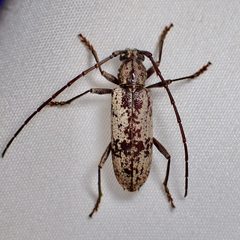
Enaphalodes niveitectus is a of longhorn beetle in the Cerambycidae, described by Schaeffer in 1905. It belongs to the tribe Elaphidiini, a group of primarily beetles often attracted to artificial light sources. The species has been documented in the southwestern United States and Mexico, with specific observations from oak-juniper woodland in southeastern Arizona.
Pronunciation
How to pronounce Enaphalodes niveitectus: /ɛnəˈfæloʊdiːzˌnaɪviˈɛktəs/
These audio files are automatically generated. While they are not always 100% accurate, they are a good starting point.
Identification
As a member of the Elaphidiini, E. niveitectus likely exhibits the tribe's characteristic features: elongated body form, or slightly serrate , and often patterned . Definitive identification requires comparison with in the Enaphalodes, which includes with varying degrees of elytral maculation and pronotal sculpturing. Specific diagnostic features for E. niveitectus are not well documented in available sources.
Images
Habitat
Documented from oak-juniper woodland in southeastern Arizona. The has been collected at light stations in mixed oak woodland environments, suggesting association with woodland that support its presumed larval in hardwood trees.
Distribution
Recorded from Middle America and North America, specifically from Mexico (MX) and the United States (US). Observations include the Santa Rita Mountains in southeastern Arizona.
Seasonality
activity has been observed in late July, based on light trap collections in southeastern Arizona during this period.
Behavior
are and attracted to mercury-vapor and ultraviolet light sources. This is consistent with other members of the Elaphidiini and has been documented at light stations in oak-juniper woodland.
Similar Taxa
- Enaphalodes cortiphagusCongeneric also occurring in southwestern oak woodlands and attracted to light; E. cortiphagus has been documented in similar and may overlap in distribution and seasonal activity
- Other Elaphidiini genera (e.g., Aneflomorpha, Tigrinestola)Share light-attracted and woodland preferences; require careful examination of antennal structure, pronotal shape, and elytral pattern for distinction
More Details
Collection method
The only specific observation of this in the provided sources came from a mercury-vapor/ultraviolet light setup in oak/juniper woodland in the Santa Rita Mountains, Arizona, on July 30, 2021. This suggests the species may be more readily collected by light trapping than by beating or sweeping methods.