
Eburia haldemani
LeConte, 1851
Ivory-marked Longhorn
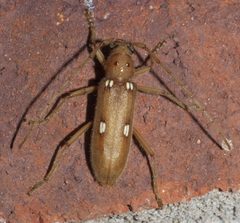
Eburia haldemani is a long-horned beetle in the Cerambycidae, distributed across Central and North America. It is frequently confused with the eastern Eburia quadrigeminata (ivory-marked ), but differs in lacking prominent spines at the elytral apex and having less elongated basal markings. are attracted to ethanol and wine-baited traps, and larvae develop in dead or dying wood of Celtis reticulata (net-leaved hackberry) and related . The has been collected in Oklahoma, Texas, and adjacent regions, with adults active from late spring through late summer.
Pronunciation
How to pronounce Eburia haldemani: //ˈɛb.jʊ.rɪə hælˈdɛ.məˌnaɪ//
These audio files are automatically generated. While they are not always 100% accurate, they are a good starting point.
Identification
Distinguished from the similar Eburia quadrigeminata by the absence of prominent spines at the apex of the and by having less elongated ivory-colored marks at the base of the elytra. The two are frequently found together in traps and are often recorded as 'Eburia haldemani/quadrigeminata' when field identification is uncertain.
Images
Habitat
Associated with riparian and woodland containing Celtis reticulata (net-leaved hackberry) and related woody . are frequently captured in baited traps placed in canyon woodlands, mesquite chaparral, and juniper-oak woodlands.
Distribution
Central America and North America; specifically recorded from Mexico (MX) and the United States. In the U.S., documented from Oklahoma (Alabaster Caverns State Park, Gloss Mountain State Park, Beaver Dunes Park, Black Mesa State Park area), Texas ( Breaks State Park), and adjacent southwestern states.
Seasonality
have been collected from late May through late August, with peak activity in July and August. At lights, adults have been recorded from late July into late August.
Host Associations
- Celtis reticulata - larval Larvae develop in dead or dying trunks and branches; and pupae have been extracted from pupal in dead wood
Life Cycle
Larvae are wood-borers that develop in dead or dying trunks and branches of trees. occurs in -lined pupal within the wood. emerge from pupal cells and may be found as adults within the wood or as fully hardened adults at lights and traps.
Behavior
are attracted to ethanol and sweet red wine baits, often captured in large numbers in 'jug traps' baited with these substances. They are also attracted to ultraviolet and mercury-vapor lights. Adults have been observed flying to lights and on tree trunks.
Ecological Role
Human Relevance
Of interest to entomologists studying longhorned beetle diversity and -trap efficacy. Frequently captured in ethanol-based insect trapping studies. The similar appearance to E. quadrigeminata creates identification challenges for collectors and researchers.
Similar Taxa
- Eburia quadrigeminataVery similar appearance and overlapping distribution; distinguished by presence of prominent elytral spines and more elongated basal ivory marks. The two are often found together in traps.