
Eburiini
Blanchard, 1845
Genus Guides
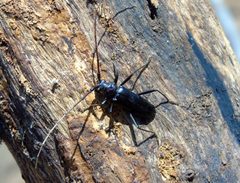
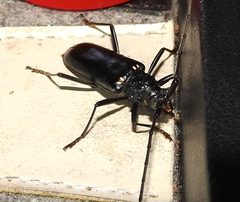
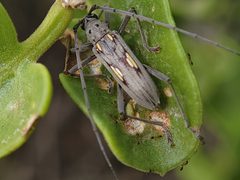
3Eburiini is a tribe of longhorn beetles in the Cerambycinae, comprising 24 and approximately 268 . The tribe is restricted to the Americas, with distribution spanning North, Central (including Caribbean), and South America. Recent taxonomic revisions have clarified its boundaries, including the synonymy of Heteropsini with Eburiini and the resurrection of Dychophyiini for excluded genera. The tribe includes economically and taxonomically significant genera such as Eburia, Beraba, and Eburiola.
Pronunciation
How to pronounce Eburiini: /ɛˌbʊˈriː.aɪ.naɪ/
These audio files are automatically generated. While they are not always 100% accurate, they are a good starting point.
Identification
of Eburiini can be distinguished from related cerambycine tribes by morphological characters used in cladistic analysis, including features of the , pronotum, and . The tribe historically included now placed in Dychophyiini; current Eburiini is defined by synapomorphies recovered in phylogenetic analysis. Identification to genus level requires examination of detailed morphological characters, with published keys available for Beraba, Eburella, and Quiacaua.
Images
Habitat
Tropical dry forest has been documented for some . Collection records indicate presence in lowland tropical areas, with specimens captured at elevations around 324 m in the Colombian Caribbean region.
Distribution
Restricted to the Americas: North America, Central America (including Caribbean), and South America. Documented from Panama through South America, with specific records from Ecuador, Colombia, Mexico, and the Caribbean region of Colombia.
Seasonality
activity has been observed February through May in the Colombian Caribbean, based on collection records.
Behavior
have been observed attracted to UV light traps and white light traps.
Similar Taxa
- DychophyiiniResurrected tribe that now contains formerly placed in Heteropsini but excluded from Eburiini; distinguished by morphological characters in cladistic analysis.
- HeteropsiniFormerly considered a separate tribe, now synonymized with Eburiini; the type Heterops was transferred to Eburiini based on phylogenetic analysis.
More Details
Taxonomic History
The tribe has undergone significant revision. The cladistic analysis by Nascimento and colleagues (2018) demonstrated that Eburiini was not monophyletic as previously circumscribed. To recover monophyly, Heterops and Eburiola were transferred from Heteropsini to Eburiini, resulting in synonymy of the two tribes with Eburiini having priority. Dychophyiini was resurrected to accommodate the remaining . The subgenus Eburia (Eleutho) was elevated to genus rank, and Opades was synonymized with Pantomallus.
Research Methods
Taxonomic studies of Eburiini rely heavily on morphological examination of specimens. Recent descriptions and revisions have utilized cladistic analysis with matrices of adult morphological characters, including 105 characters in the most comprehensive analysis. Light trapping (UV and white light) has been the primary collection method documented in recent studies.
Sources and further reading
- BugGuide
- Wikipedia
- iNaturalist taxon
- NCBI Taxonomy
- Catalogue of Life
- Two new species of Beraba Martins, 1997 and new geographical records of Eburiini (Coleoptera, Cerambycidae)
- Three new species, a lectotype designation, and taxonomic and geographic notes in Eburiini (Coleoptera, Cerambycidae, Cerambycinae)
- Cladistic analysis of the tribe Eburiini Blanchard, 1945 and revalidation of the tribe Dychophyiini Gistel, 1848 (Coleoptera: Cerambycidae)
- Eburiini (Coleoptera, Cerambycidae, Cerambycinae) from the Colombian Caribbean: description of a new species of Beraba Martins, 1997 and new geographical records