
Dryobius
LeConte, 1850
Species Guides
1- Dryobius sexnotatus(Six-banded Longhorn Beetle)
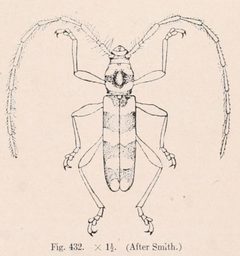
Dryobius is a monospecific of longhorn beetles ( Cerambycidae) containing only Dryobius sexnotatus. The genus name derives from Greek roots meaning "tree-dwelling." The sole is distributed across the eastern United States, with highest concentration in the Ohio River Valley. Larvae develop in hardwood trees including maple, beech, basswood, and elm.
Pronunciation
How to pronounce Dryobius: //ˈdɹaɪoʊbiəs//
These audio files are automatically generated. While they are not always 100% accurate, they are a good starting point.
Images
Distribution
Eastern United States, with most specimens documented from the Ohio River Valley. Recorded from at least fourteen states across the region.
Seasonality
period extends from early March through early September, with peak activity from mid-June through mid-July.
Diet
Larvae feed on maple (Acer), beech (Fagus), basswood (Tilia), and elm (Ulmus) trees. Specific feeding habits of are not documented.
Host Associations
- Acer - larval maple
- Fagus - larval beech
- Tilia - larval basswood
- Ulmus - larval elm
Behavior
Males produce including 1-(1H-pyrrol-2-yl)-1,2-propanedione and (R)-3-hydroxyhexan-2-one. Specific mating or are not documented.
Ecological Role
Larval wood-borer in hardwood trees; contributes to nutrient cycling in forest through decomposition of dead and dying wood.
More Details
Etymology
The generic name Dryobius comes from Greek δρῦς (drus, "tree") and βιόω (bioō, "to live"), referring to the arboreal lifestyle of the .
Taxonomic history
Originally described by Thomas Say as Callidium 6-fasciatum, the was transferred to the new Dryobius by John Lawrence LeConte in 1850. The specific epithet was emended to sexfasciatus in 1859, then replaced with sexnotatus by Earle Gorton Linsley in 1957 due to a preoccupied homonym.