
Rosalia funebris
Motschulsky, 1845
Banded Alder Borer
Rosalia funebris, commonly known as the Banded Alder Borer, is a striking longhorn beetle in the Cerambycidae. It is notable for its bold black-and-white coloration and elongated body form. are active in spring and summer and are frequently observed on the bark of hardwood trees, particularly alders. The is native to western North America, ranging from Alaska to California and New Mexico. Unlike many wood-boring beetles, it is not considered a significant pest as it generally lays in downed rather than living trees.

Pronunciation
How to pronounce Rosalia funebris: /roˈsaː.li.a fuˈneː.bris/
These audio files are automatically generated. While they are not always 100% accurate, they are a good starting point.
Identification
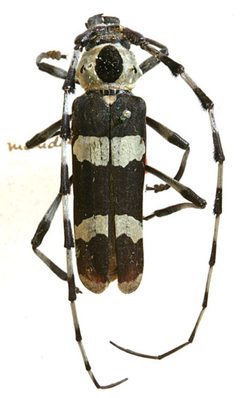
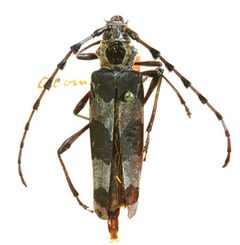
Distinguished from other Rosalia by its western North American distribution and specific banding pattern of three white bands on dark . The white pronotum with single large black spot separates it from many other cerambycids with spotted or uniformly colored pronota. The banded are also distinctive. May be confused with other boldly patterned longhorn beetles, but the combination of banded elytra, spotted pronotum, and banded antennae is diagnostic.
Images
Appearance
Elongate, narrow body reaching up to 38 mm in length. dark with three distinct white transverse bands. Pronotum white with a large central black spot. banded white and black; in males, antennae exceed body length, while in females they are shorter than the body. Overall coloration is high-contrast black and white.
Habitat
Associated with hardwood forests, particularly near alder trees. found on bark of trees including Oregon ash, New Mexico willow, and California laurel/Oregon myrtle. Also attracted to recently painted buildings, where they may congregate in large numbers. Larval is within wood of downed hardwood trees.
Distribution
Western North America: Alaska through California, and in New Mexico. Present in British Columbia, Canada.
Seasonality
Active in spring and summer. observed on tree bark during these seasons.
Diet
feed on flowers. Larvae consume wood of hardwood trees.
Host Associations
- Alnus - associationFrequently found on bark; derives from this association
- Fraxinus latifolia - oviposition substrateOregon ash; laid in bark crevices, larvae bore into wood
- Salix - oviposition substrateNew Mexico willow
- Umbellularia californica - oviposition substrateCalifornia laurel/Oregon myrtle
Life Cycle
lay in crevices of hardwood tree bark. Larvae bore into wood, creating circular cross-section tunnels that run straight for short distances between turns. Larval tunnels distinct from the oval cross-section tunnels of Buprestidae larvae. Developmental details beyond larval boring not documented in available sources.
Behavior
make audible squeaking or hissing sounds when handled or threatened, similar to a squeaky running shoe or air escaping from a bicycle tire. Adults are attracted to recently painted buildings in large numbers, though the reason for this is unknown.
Ecological Role
Larvae contribute to wood decomposition in downed hardwood trees. may serve as when feeding on flowers. Not considered a significant pest due to preference for dead or downed wood rather than living trees.
Human Relevance
Not a significant economic pest. Attraction to painted buildings can result in nuisance . Occasionally encountered by entomologists and naturalists due to striking appearance. Subject of citizen science observations with over 3,000 records on iNaturalist.
Similar Taxa
- Rosalia alpinaEuropean with similar elongated body form and bold coloration, but occurs in Europe rather than western North America and has different pattern details
More Details
Paint attraction
The reason for attraction to recently painted buildings remains unknown, but this results in conspicuous that make the easily observable in human-modified environments.
Larval tunnel morphology
Larval tunnels are circular in cross-section and characteristically run straight for short distances between turns, contrasting with the oval cross-section tunnels of Buprestidae larvae.