
Rosalia
Audinet-Serville, 1833
Rosalia longicorn, Alpine longhorn beetle
Species Guides
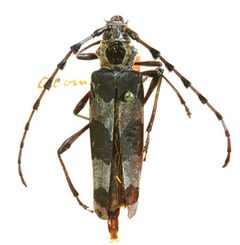
1- Rosalia funebris(Banded Alder Borer)
Rosalia is a of longhorn beetles (Cerambycidae) established by Audinet-Serville in 1833. The genus includes the iconic Rosalia alpina, known as the Rosalia longicorn or Alpine longhorn , a large and strikingly colored protected under the European Union Directive. Members of this genus are associated with beech forests and have experienced significant range contractions across Europe due to habitat loss and forest management practices. The genus is characterized by elongated bodies, long , and often distinctive coloration including blue-gray tones with black spots.


Pronunciation
How to pronounce Rosalia: /rɔˈsaːli.a/
These audio files are automatically generated. While they are not always 100% accurate, they are a good starting point.
Identification
Large longhorn beetles with elongated cylindrical bodies. typically display blue-gray with contrasting black spots or markings. are notably long, often exceeding body length in males. The overall size ranges from 15-38 mm, making them among the more conspicuous cerambycids. Rosalia alpina specifically shows a velvety blue-gray coloration with variable black spotting.
Images
Habitat
Deciduous forests, primarily associated with European beech (Fagus sylvatica) in central Europe. also occupy outside dense forests including roadside trees, woodlots in pasturelands, and forest edges. Thermal conditions influence habitat use, with beetles sometimes avoiding the coolest interior forest areas.
Distribution
Euro-Caucasian distribution. In Europe: Alps, Carpathians, Balkans, and scattered in central Europe. Northern limit runs through southern Germany, northern Czech Republic (not beyond Sudeten Mountains), and southern Poland. In Poland, currently restricted to the Carpathians with continuous distribution in Bieszczady Zachodnie and Beskid Niski Mountains, scattered sites in Beskid Sądecki, Pieniny Mountains, and Sanok-Turka Mountains. Formerly occurred in Świętokrzyskie Mountains, Roztocze Upland, Lower Silesia, and northern Poland.
Diet
wood-boring larvae; primarily associated with European beech (Fagus sylvatica) in central Europe. Larval development occurs in dead or decaying wood of trees.
Host Associations
- Fagus sylvatica - primary European beech; main for larval development in central European
Behavior
are capable of and have been observed moving between forest patches. Mark-recapture studies indicate regular movement distances up to 3000 m, with nearest neighbor distance between sites of approximately 1023 m. Adults are attracted to wood stacks and beech timber at depots, which can act as ecological traps. Maximum abilities remain unknown.
Ecological Role
Saproxylic dependent on dead wood; contributes to nutrient cycling in forest . As a large, conspicuous , serves as an for old-growth forest conditions and conservation status of saproxylic .
Human Relevance
Rosalia alpina is protected under Annexes II and IV of the European Union Directive, making it a flagship for saproxylic conservation. Subject to intensive monitoring efforts including citizen science programs. declines and range contractions have made it a focus of conservation concern. Formerly collected for entomological collections, now protected throughout its range.
Similar Taxa
- Morimus funereusBoth are large, saproxylic cerambycids protected under EU Directive; similar size and dark coloration, but Morimus lacks the blue-gray tones and spotted pattern of Rosalia
- Cerambyx cerdoAnother large European cerambycid of comparable size; distinguished by uniformly dark coloration and different antennal proportions
- Lucanus cervus shares preferences and protected status; easily distinguished by enlarged in males and different body form
Sources and further reading
- BugGuide
- Wikipedia
- GBIF taxonomy match
- iNaturalist taxon
- NCBI Taxonomy
- Catalogue of Life
- nature conservation | Blog - Part 3
- Coleoptera | Blog - Part 2
- Current distribution of the Rosalia longicorn Rosalia alpina (LINNAEUS, 1758) (Coleoptera: Cerambycidae) in Poland
- Description and Analysis of the Arch Display in the Golden Lion Tamarin, Leontopithecus rosalia rosalia
- Analisis Learning Obstacles Siswa Kelas VIII Pada Materi Segitiga Rosalia Anisa