
Phymatodes testaceus
(Linnaeus, 1758)
tanbark borer, violet tanbark beetle
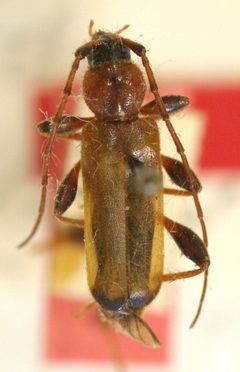
Phymatodes testaceus is a transpalearctic polymorphic longhorn beetle in the Cerambycinae. range from 6–16 mm in length. The exhibits significant color variation, with some individuals showing violet or metallic reflections that contribute to the 'violet tanbark beetle.'
Pronunciation
How to pronounce Phymatodes testaceus: /faɪˈmeɪtəˌdiːz tɛˈsteɪsiˌuːs/
These audio files are automatically generated. While they are not always 100% accurate, they are a good starting point.
Identification
The combination of small size (6–16 mm), highly variable coloration including tan to violet-brown tones, and association with bark of deciduous trees distinguishes this from similar Phymatodes. The polymorphic coloration can cause confusion with other Phymatodes species; examination of antennal structure and male genitalia may be necessary for definitive identification. The violet metallic reflections, when present, are distinctive but not universal.
Images
Habitat
Deciduous forests and woodlands. Larvae develop in and under the bark of various deciduous tree . are found on or near trees, particularly those with damaged or loosening bark.
Distribution
Transpalearctic distribution extending from the European Atlantic coastline eastward to the Southern Ural Mountains, and from southern Sweden and Norway south to North Africa and Syria. Introduced and established in North America and Japan.
Seasonality
are active during warmer months. Larvae pupate in spring. In central and southern portions of its range, the completes in one year; in northern regions, development extends to two years.
Diet
Larvae feed on phloem and cambium tissues beneath the bark of deciduous trees. Specific tree are various but details are not well documented in available sources.
Host Associations
- various deciduous trees - larval developmentLarvae develop in and under bark, causing damage to phloem and cambium tissues
Life Cycle
(1 mm) are deposited under bark or in bark crevices. Larvae (10–18 mm) feed beneath bark, creating galleries in phloem and outer sapwood. occurs in spring within the bark or superficial wood. The complete cycle spans one year in temperate regions, two years in northern climates.
Behavior
Larvae are subcortical borers, creating feeding galleries that can girdle or weaken branches. are likely or , typical of many cerambycids, though specific behavioral observations are limited in available sources.
Ecological Role
As a subcortical borer, larvae contribute to nutrient cycling by breaking down woody tissues and creating for other organisms in dead and dying wood. In high densities, may contribute to tree stress or mortality, particularly of already compromised trees.
Human Relevance
Considered a minor forest pest due to larval damage beneath bark of deciduous trees. The 'tanbark borer' reflects historical association with oak bark used in tanning processes. No significant economic impact documented, but may affect timber quality in localized .
Similar Taxa
- Other Phymatodes speciesSimilar size range and subcortical larval habits; reliable separation requires examination of antennal segment ratios, elytral , and male genitalia
- Other Cerambycinae in CallidiiniShared tribe characteristics including small to medium size and bark-associated larvae; Phymatodes testaceus distinguished by polymorphic coloration and specific geographic range
More Details
Taxonomic Complexity
The Phymatodes has undergone significant nomenclatural revision in North America, with multiple synonymies and misapplied names corrected by Swift & Ray (2010). However, P. testaceus itself, as a transpalearctic described by Linnaeus in 1758, has remained taxonomically stable.
Polymorphism
The exhibits notable color , with individuals ranging from plain tan to those with strong violet or metallic reflections. This variation has contributed to multiple and potential confusion with other species.