
Callidium frigidum
Casey, 1912
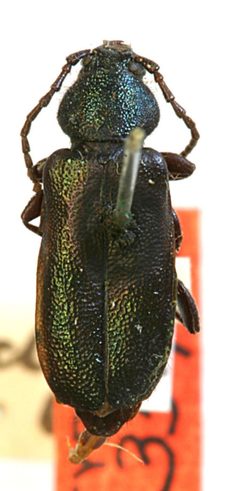
Callidium frigidum is a of longhorned beetle in the Cerambycidae, described by Casey in 1912. The species belongs to the tribe Callidiini within the Cerambycinae. It is known from northern North America, with records from Canada including Newfoundland, Ontario, and Québec. As a member of the Callidium, it is associated with coniferous trees, though specific associations for this species have not been documented in the available sources.
Pronunciation
How to pronounce Callidium frigidum: //kəˈlɪdiəm ˈfrɪdʒɪdəm//
These audio files are automatically generated. While they are not always 100% accurate, they are a good starting point.
Identification
Members of the Callidium can be distinguished from similar cerambycid genera by their compact, somewhat cylindrical body form and that are typically shorter than the body length. Specific diagnostic features for C. frigidum distinguishing it from such as C. violaceum or C. antennatum are not documented in available sources. The name 'frigidum' (Latin for 'cold') may allude to its northern distribution or preferences.
Images
Habitat
Based on distribution records, the occurs in northern forested regions of North America. The specific requirements within these regions are not documented.
Distribution
Recorded from Canada: Newfoundland, Ontario, and Québec. The is present in North America according to GBIF distribution records.
Similar Taxa
- Callidium violaceumAnother North American Callidium with overlapping distribution; specific distinguishing features for C. frigidum are not documented
- Callidium antennatumCongeneric in the same tribe Callidiini; differentiation requires examination of subtle morphological characters not specified in available sources
More Details
Taxonomic placement
The was described by Thomas Lincoln Casey Jr., a prolific American coleopterist, in 1912. It is classified in the tribe Callidiini, which contains species typically associated with coniferous trees.