
Acmaeodera opacula
LeConte, 1858
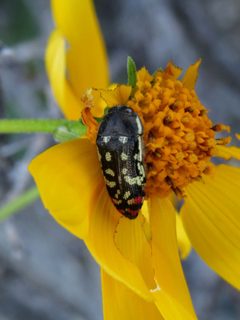
Acmaeodera opacula is a metallic wood-boring beetle in the Buprestidae. It occurs in western North America, with records from New Mexico and Arizona. are flower-visitors, having been observed on flowers of Grindelia nuda, Picradeniopsis absinthifolia, Fallugia paradoxa, and Gutierrezia sarothrae. The was formerly known as A. disjuncta. It is active in late summer and fall, with observations from September.
Pronunciation
How to pronounce Acmaeodera opacula: //ækmiːoʊˈdɛrə oʊˈpækjʊlə//
These audio files are automatically generated. While they are not always 100% accurate, they are a good starting point.
Identification
Acmaeodera opacula can be distinguished from similar by its specific elytral pattern and coloration. Field identification requires close examination of elytral markings; it is smaller than A. amplicollis and lacks the red pronotal markings of A. rubronotata. It has been observed sympatrically with A. rubronotata, A. amplicollis, and A. maculifera on shared flower , requiring careful observation to separate.
Images
Habitat
Juniper-oak-pinyon woodland and mesquite-acacia thornscrub. are associated with flowering plants in open, dry with mixed woodland and scrub vegetation. Elevation range includes mid- to high-altitude sites, with observations from approximately 1500-2000m.
Distribution
Western North America: documented from New Mexico (Eddy County, Doña Ana County, Chaves County) and Arizona (Mojave County). GBIF records indicate presence in the Nearctic region.
Seasonality
Late summer to fall activity. Documented observations from September, with peak activity likely occurring during this period.
Diet
feed on pollen and nectar of flowering plants. Documented flower include Grindelia nuda (curlycup gumweed), Picradeniopsis absinthifolia (hairyseed bahia), Fallugia paradoxa (Apache plum), and Gutierrezia sarothrae (broom snakeweed). Larval diet unknown, presumed to be wood-boring in host plants as typical for the .
Host Associations
- Grindelia nuda - flower curlycup gumweed
- Picradeniopsis absinthifolia - flower hairyseed bahia
- Fallugia paradoxa - flower Apache plum
- Gutierrezia sarothrae - flower broom snakeweed
Life Cycle
Larval development presumed to occur in woody plants, typical for Acmaeodera. emerge in late summer and fall. Specific details of larval host plants and developmental timing are not documented.
Behavior
are flower visitors, actively foraging on composite flowers during daylight hours. They have been observed sharing flower with multiple and other . unknown. Attracted to ultraviolet and visible light in bottle traps.
Ecological Role
Human Relevance
Of interest to entomologists and coleopterists as a representative of the diverse Acmaeodera fauna of the southwestern United States. No documented economic or agricultural significance. Occasionally captured in insect traps used for biodiversity surveys.
Similar Taxa
- Acmaeodera rubronotataSympatric and shares flower ; distinguished by red pronotal markings and larger size
- Acmaeodera amplicollisSympatric and shares flower ; larger with different elytral pattern
- Acmaeodera maculiferaSympatric on shared flower ; distinguished by elytral maculation pattern
More Details
Nomenclatural history
This was formerly treated under the name Acmaeodera disjuncta. The current accepted name A. opacula LeConte, 1858 has priority.
Research context
Specimens have been collected in bottle traps and observed during systematic surveys of Buprestidae in New Mexico and Arizona, contributing to understanding of late-season Acmaeodera diversity in the region.