
Acmaeodera comata
LeConte, 1858
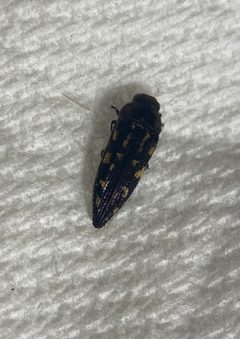
Acmaeodera comata is a of jewel beetle ( Buprestidae) in the Acmaeodera, described by John Lawrence LeConte in 1858. It belongs to the Nearctic fauna and is one of approximately 790 species and of Buprestidae recognized in North America. The species is part of the Acmaeodera (s. str.) subgenus and is included in the 'Truncatae' group, characterized by a nearly straight prosternal margin that is not retracted from the sides. Like other members of this large and taxonomically challenging genus, A. comata is poorly known biologically and lacks modern taxonomic revision.
Pronunciation
How to pronounce Acmaeodera comata: /ækˌmiːoʊˈdɛrə koʊˈmeɪtə/
These audio files are automatically generated. While they are not always 100% accurate, they are a good starting point.
Identification
Acmaeodera comata can be distinguished from other Acmaeodera by characters associated with its placement in the 'Truncatae' group: the prosternal margin is nearly straight and not retracted from the sides. Detailed diagnostic characters for this species have not been compiled in modern taxonomic treatments. The Acmaeodera as a whole is considered taxonomically difficult, with 149 species/ in North America and many species described after the last comprehensive revision (Fall 1899). Accurate identification of A. comata likely requires comparison with or determined material, as is the case for many .
Images
Distribution
Acmaeodera comata occurs in the Nearctic region, specifically in North America. The was described by LeConte in 1858, suggesting it was originally described from material collected in the United States. GBIF records indicate presence in the Nearctic and Neotropic regions, with confirmed occurrence in Middle America and North America.
Human Relevance
Acmaeodera comata is of interest to coleopterists and buprestid . The appears on collection desiderata lists, indicating it is sought by collectors attempting to document the North American fauna comprehensively. It was listed among species missing from the T.C. MacRae Collection as of 2013, suggesting it may be uncommon or difficult to acquire. No economic or pest significance has been documented.
Similar Taxa
- Acmaeodera tubulusBoth belong to the 'Truncatae' group and share the characteristic prosternal structure; however, A. tubulus is widespread and common in the eastern United States, whereas A. comata has a different distribution pattern.
- Acmaeodera conoideaAnother member of the 'Truncatae' group described in the same era; in this group are distinguished by subtle morphological characters that are not well summarized in accessible literature.
- Other Acmaeodera (s. str.) speciesThe subgenus contains numerous with similar general buprestid —elongate body, metallic coloration, punctate —requiring careful examination of prosternal, pronotal, and elytral characters for separation.
Sources and further reading
- BugGuide
- GBIF taxonomy match
- iNaturalist taxon
- Catalogue of Life
- Grasshoppers of Colorado
- Grasshoppers of Colorado
- Let’s make a deal! | Beetles In The Bush
- An uncommon fall-active Acmaeodera | Beetles In The Bush
- Acmaeodera carlota in northern Arizona | Beetles In The Bush
- Introducing Acmaeodera chuckbellamyi | Beetles In The Bush