
Sphenoptera
Dejean, 1833
Species Guides
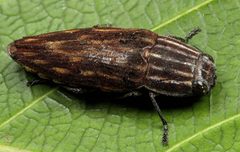
1- Sphenoptera jugoslavica(bronze knapweed root borer)
A large of jewel beetles (Buprestidae) comprising over 1,000 described . Species occupy diverse including stem borers, gall formers, and root borers across multiple continents. Several species are economically significant as pests of agricultural crops, forestry trees, and medicinal plants, while others have been investigated for of weeds.
Pronunciation
How to pronounce Sphenoptera: /sfɛˈnɒptɛrə/
These audio files are automatically generated. While they are not always 100% accurate, they are a good starting point.
Identification
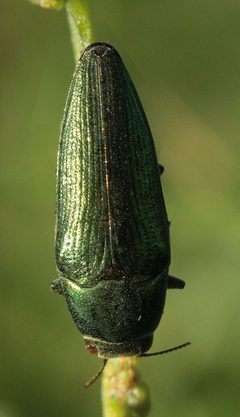
Members of this can be recognized by the combination of: body typically elongated and somewhat flattened; antennal serrations beginning at antennomere 4 or 5; prosternal process narrow and elongate; and elytral apices often or . Subgenera are distinguished by structural features such as clypeal presence or absence, pronotal shape, and elytral patterns. -level identification requires examination of male genitalia and detailed microsculpture.
Images
Habitat
vary substantially by and include: arid and semi-arid steppe environments (subgenus Chilostetha); agricultural landscapes with stone fruit orchards; cotton fields; Acacia woodlands; and wild of medicinal plants. Many species are associated with specific plants for larval development.
Distribution
Widespread across the Palaearctic region, with significant representation in the Middle East, Central Asia, and the Mediterranean. Also present in Africa (Sudan, Nigeria, Senegal, Tunisia, South Africa), South Asia (India, Pakistan, Sri Lanka, Myanmar), and introduced established in North America (Canada, USA) for purposes.
Diet
Larvae of most are internal feeders: stem borers, root borers, or gall formers within plant tissues. Specific feeding habits vary by species and include: boring under bark of stems and branches; forming galls in rosettes; mining in roots; and tunneling in woody stems. of some species feed on host plant tissues, though adult feeding habits are less documented.
Host Associations
- Prunus domestica (plum) - Sphenoptera servistana; primary with 73% rate
- Prunus armeniaca (apricot) - Sphenoptera servistana; secondary with 24% rate
- Centaurea diffusa (diffuse knapweed) - Sphenoptera jugoslavica; monophagous gall former in rosettes
- Gossypium spp. (cotton) - Sphenoptera gossypii; stem borer
- Acacia nilotica - Sphenoptera chalcichroa arenosa; causes die-back and mortality
- Sutherlandia frutescens (cancer bush) - Sphenoptera sp.; newly confirmed association causing substantial damage to wild
Life Cycle
details vary by . Sphenoptera servistana: stage mid-May to late September (135 days); larval stage present most of the year (longest duration); pupal stage April 7 to May 21 (44 days, including within larval tunnel); stage May 22 to late September (128 days, including from tunnels). Sphenoptera jugoslavica: , with arrested plant growth required during oviposition period. Most species complete development within plant tunnels with adults emerging to mate and oviposit on external bark surfaces.
Behavior
Larvae exhibit internal boring , creating tunnels in wood, stems, roots, or forming galls. are often observed on plants during active periods. Some show strong host fidelity with specialized chemical, structural, phenological, and biological requirements for host recognition and acceptance. Sphenoptera jugoslavica fluctuate substantially based on weather-dependent plant growth patterns.
Ecological Role
Roles vary by : some function as significant pests causing tree mortality, growth reduction, and economic damage in forestry and agriculture; others have been deployed as agents to suppress weeds. Larval tunneling disrupts vascular transport in plants. are influenced by (e.g., Dolichomitus terebrans), , and plant defensive responses including callus formation.
Human Relevance
Multiple are economically important pests: Sphenoptera servistana damages stone fruit orchards in Iraq; Sphenoptera gossypii is a cotton pest across Africa and South Asia; Sphenoptera chalcichroa arenosa causes mortality of Acacia nilotica in Sudan. Sphenoptera jugoslavica was introduced to North America as a agent for diffuse knapweed (Centaurea diffusa). A newly confirmed Sphenoptera sp. threatens wild of the medicinal plant Sutherlandia frutescens in South Africa.
Similar Taxa
- Other Buprestidae generaSphenoptera is distinguished from related buprestid by the combination of antennal structure, prosternal process , and elytral apex configuration; subgeneric divisions within Sphenoptera are based on clypeal, pronotal, and elytral characters
More Details
Taxonomic complexity
The contains numerous subgenera including Chrysoblemma, Chilostetha, Hoplistura, Tropeopeltis, and Clypeostetha, with extensive synonymy established through recent revisions. Over 1,000 have been described, making this one of the largest genera in Buprestidae.
Biological control potential
specificity in Sphenoptera jugoslavica is based on a combination of chemical, structural, phenological, and biological characteristics present only in Centaurea diffusa and closely related , demonstrating the specialized host relationships that can make certain species suitable for while limiting non-target risk.
Sources and further reading
- BugGuide
- Wikipedia
- GBIF taxonomy match
- iNaturalist taxon
- NCBI Taxonomy
- Catalogue of Life
- Sphenoptera gossypii . [Distribution map].
- A new species of Sphenoptera (subgenus Chrysoblemma) from Iran with taxonomic notes on some Palaearctic species of Sphenoptera from subgenera Chrysoblemma, Hoplistura and Tropeopeltis (Coleoptera: Buprestidae)
- Sphenoptera sp. (Buprestidae: Coleoptera) threatening wild cancer bush (Sutherlandia frutescens) population
- تقييم الحياتية، الأضرار و حساسية بعض انواع الاشجار ذات النواة الحجرية للاصابة بحفار الاشجار ذو الرأس المسطح ،Sphenoptera servistana Obenberger, 1929 (Coleoptera: Buprestidae) BIOLOGY, DAMAGE ASSESSMENT AND SUSCEPTIBILITY OF SOME STONE FRUIT TREES TO INFESTATION BY THE FLATHEADED TREE BORER, SPHENOPTERA SERVISTANA OBENBERGER (Coleoptera: Buprestidae).
- Population Development of Sphenoptera (Tropeopeltis) tappesi Marseul and Its Parasitoid Dolichomitus terebrans (Ratzeburg)
- A new subgenus of the genus Sphenoptera Dejean, 1833 with re-description of S. epistomalis Obenberger, 1927 (Coleoptera, Buprestidae)
- Taxonomic notes on some Palaearctic species of Sphenoptera from the subgenus Chilostetha (Coleoptera: Buprestidae)
- Investigations on Sphenoptera (Chilostetha) jugoslavica Obenb. (Col. Buprestidae), a possible biocontrol agent of the weed Centaurea diffusa Lam. (Compositae) in Canada
- The effect of Sphenoptera jugoslavica Obenb. (Col., Buprestidae) on its host plant Centaurea diffusa Lam. (Compositae)
- Sphenoptera chalcichroa arenosa Ob. (Col., Buprestidae) associated with the die‐back of Acacia nilotica (L. Willd. ex Del.) in the Sudan
- Eretes sticticus (Coleoptera, Dytiscidae) - A new record for the Romanian fauna, and new data regarding the distribution of two rare species - Acinopus ammophilus (Coleoptera, Carabidae) and Sphenoptera (Chilostetha) laportei (Coleoptera, Buprestidae) in Dobrogea (Romania)