
Chalcophora georgiana
(LeConte, 1857)
Southern Sculptured Pine Borer
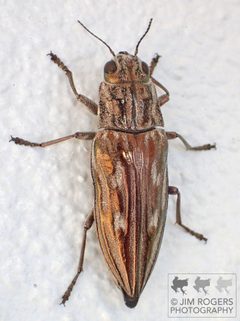
Chalcophora georgiana, the southern sculptured pine borer, is a large metallic wood-boring beetle in the Buprestidae. It is one of five North American in the Chalcophora, all commonly known as "sculptured pine borers" due to their heavily sculptured and strict association with pine trees. This species occurs in the southeastern United States, with Florida representing a core part of its range.
Pronunciation
How to pronounce Chalcophora georgiana: //kælˈkɒfərə dʒɔːrˈdʒiːənə//
These audio files are automatically generated. While they are not always 100% accurate, they are a good starting point.
Identification
One of five North American Chalcophora , distinguished from by color, presence/absence of ridges on front legs, presence/absence of spines at elytral apices, and male genitalia. The four eastern species (including C. georgiana) are distinct and easily distinguished from each other; C. georgiana is specifically associated with the southeastern United States. Maier & Ivie (2013) provide a revised key to all five North American species with high-quality images of habitus, elytral apices, and male genitalia.
Images
Appearance
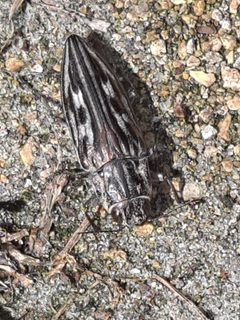
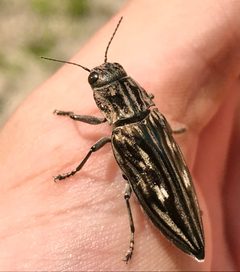
Large jewel beetle with a hyper-sculptured, shiny metallic body. The surface sculpturing and metallic coloration provide effective camouflage against pine bark. Like other Chalcophora , it exhibits dramatic sculpturing that helps it blend into its environment and become nearly invisible when positioned on appropriate substrates.
Habitat
Associated with pine trees, particularly in southeastern forested regions. are found on trunks of dead or dying pine trees where their sculptured, metallic appearance provides effective camouflage against flaked, graying bark.
Distribution
Southeastern United States; core range includes Florida. The occurs within the eastern forested regions of North America, distinct from the western C. angulicollis which is found west of the Great Plains.
Host Associations
- Pinus - larval Strict association with pine trees; larvae bore in wood
Behavior
are and active on pine trunks. Their sculptured, metallic coloration serves as camouflage rather than warning coloration—when positioned on dead or dying pine bark with flaked, graying surfaces, the beetles become nearly invisible to visual . This is highly substrate-dependent; on healthy, resin-filled, brightly colored bark, the beetles become conspicuous.
Ecological Role
Wood-boring whose larvae develop in pine wood. As a member of the Buprestidae, contributes to the decomposition of dead and dying pine trees and serves as prey for specialized such as the crabronid Cerceris fumipennis.
Human Relevance
Like other Chalcophora , may be encountered by entomologists and collectors due to its large size and striking appearance. The species has been documented in entomological surveys and is included in regional faunal studies.
Similar Taxa
- Chalcophora virginiensisMost widespread eastern ; distinguished by color, leg ridges, elytral spine presence, and male genitalia proportions
- Chalcophora libertaEastern with distinct coloration and structural features
- Chalcophora fortisEastern found in northeastern regions
- Chalcophora angulicollisWestern found west of the Great Plains; previously synonymized with C. virginiensis but reinstated as valid based on mouthpart and genitalic differences
More Details
Taxonomic History
The Chalcophora was reviewed by Maier & Ivie (2013), who provided redescriptions, a revised key, and updated distribution maps for all five North American . The name Chalcophora derives from Greek chalkos () and phoreus (bearer), though pronunciation varies among .
Cryptic Coloration Function
Unlike many brightly colored insects where metallic appearance serves aposematic or sexual functions, in Chalcophora the sculptured metallic surface provides camouflage against specific pine bark substrates. This represents an example of background matching where the 's appearance makes it effectively invisible when positioned on dead or dying pine trunks.
Sources and further reading
- BugGuide
- Wikipedia
- GBIF taxonomy match
- iNaturalist taxon
- Catalogue of Life
- Review of North American Chalcophora | Beetles In The Bush
- Buprestidae | Beetles In The Bush | Page 8
- Coleoptera | Beetles In The Bush | Page 10
- Super Crop Challenge #11 | Beetles In The Bush
- ID Challenge #19 | Beetles In The Bush
- Bug Eric: Beetle Bonanza