
Chalcophora angulicollis
(LeConte, 1857)
western sculptured pine borer, sculptured pine borer
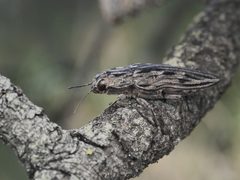
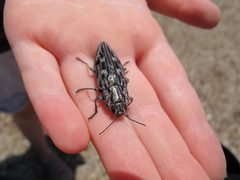
Chalcophora angulicollis is a large metallic wood-boring beetle in the Buprestidae, commonly known as the western sculptured pine borer. It is one of the largest jewel beetles in western North America, measuring 20–33 mm in length. The is strictly associated with pine trees (Pinus spp.), where larvae develop in dead or dying wood. are active during daylight hours and are frequently observed running on or flying to recently fallen or injured pine trunks and branches. The species was historically confused with the eastern Chalcophora virginiensis but was reinstated as valid based on distinct morphological differences in mouthparts, male genitalia, and elytral margins.
Pronunciation
How to pronounce Chalcophora angulicollis: /ˌkælkəˈfɔːrə ˌæŋɡjʊliˈkɒlɪs/
These audio files are automatically generated. While they are not always 100% accurate, they are a good starting point.
Identification
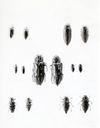
Distinguished from the eastern Chalcophora virginiensis by: (1) maxillary palpomere flattened and relatively shorter versus cylindrical and longer in C. virginiensis; (2) male genitalia less than 3.3 times as long as wide versus more than 3.9 times as long as wide in C. virginiensis; (3) posterolateral elytral margin weakly serrate to crenulate versus weakly to strongly serrate in C. virginiensis; (4) slightly more cupreous coloration and more robust build. Distinguished from other western Buprestidae by its large size, highly sculptured surface, and strict association with pine. The angulate pronotal sides separate it from C. virginiensis, which has rounded pronotal sides.
Images
Appearance
Large, robust with highly sculptured, metallic bronze to coppery-brown and pronotum. Body length 20–33 mm. surface covered with intricate, raised sculpturing that provides camouflage against pine bark. Pronotum with distinctly angulate (angled) sides—this feature gives the its name. serrate. Elytra with weakly serrate to crenulate posterolateral margins. When in , exposes bright blue, green, or violet abdominal tergites. maxillary palpomere flattened and relatively shorter than in the similar eastern species C. virginiensis.
Habitat
Pine forests and woodlands, particularly areas with recently dead, dying, or injured pine trees. are found on trunks and branches of Pinus , especially those with loose bark or exposed sapwood. Larval is within the wood of dead or declining pines. Occurs from lowland to montane elevations in western North America.
Distribution
Western North America: from western Canada (British Columbia, Alberta) south through the western United States. Records include Idaho, Montana, Wyoming, Colorado, Utah, Arizona, New Mexico, and potentially adjacent areas. The distribution is nearly completely disjunct from that of C. virginiensis, separated by the treeless Great Plains.
Seasonality
are active from late spring through summer, with peak activity likely varying by elevation and latitude. In Colorado, adults have been observed in June. Activity appears to coincide with warm, sunny conditions when adults can be seen running on pine trunks or taking when disturbed.
Diet
Larvae feed on dead or dying wood of pine trees (Pinus spp.), tunneling through sapwood and heartwood. Specific feeding habits of are not documented, but adults of related do not feed; they rely on larval reserves for their brief adult life.
Host Associations
- Pinus ponderosa - larval ponderosa pine
- Pinus edulis - larval Colorado pinyon pine
- Pinus - larval -level association with pines
Life Cycle
Complete with , larval, pupal, and stages. Larvae develop within dead or dying pine wood, creating galleries as they feed. occurs within the wood, with adults emerging through exit holes. Adults are and active on the surface of trees, where they seek mates and oviposition sites on suitable dead or declining wood. The full duration of development is not documented but likely spans one to multiple years depending on conditions.
Behavior
are and frequently observed running rapidly on pine trunks and branches. When disturbed, they fly readily, exposing brightly colored abdominal tergites. Males and females are both active on trees, with females seeking dead or dying wood for oviposition. Adults are attracted to recently injured, dying, or fallen pines, likely detecting host trees through volatile chemical cues emitted by stressed wood. The sculptured, metallic coloration provides effective against pine bark when the is stationary.
Ecological Role
Primary decomposer of dead pine wood; larvae contribute to nutrient cycling in pine forest . As a on pines, the helps process dead and dying trees, facilitating and stand renewal. serve as prey for visual including birds and reptiles, though their cryptic coloration and rapid escape reduce risk.
Human Relevance
Of minor economic significance; may be encountered in logging operations and sawmills where fresh-cut pine logs are present. The is not considered a primary pest, as it colonizes already dead or dying wood rather than killing healthy trees. Attracted to logging debris and injured trees. Of interest to coleopterists and naturalists due to its large size and striking appearance.
Similar Taxa
- Chalcophora virginiensisSimilar large size, sculptured appearance, and pine association; distinguished by morphological differences in mouthparts, male genitalia proportions, and pronotal shape (rounded versus angulate sides). Eastern distribution versus western for C. angulicollis.
- Chalcophora libertaAnother eastern sculptured pine borer; smaller and with different elytral sculpturing pattern. Not sympatric with C. angulicollis.
- Buprestis spp.Large, metallic Buprestidae that may occur on pines; distinguished by less pronounced sculpturing, different body proportions, and elytral patterns.
Misconceptions
Historically treated as a synonym of Chalcophora virginiensis by some authors (Bright 1987), but subsequently reinstated as a valid based on consistent morphological differences. The two species are not despite superficial similarity and were never truly sympatric due to the geographic barrier of the Great Plains.
More Details
Taxonomic History
The was described by LeConte in 1857 as Buprestis angulicollis. It was later transferred to Chalcophora. Bright (1987) synonymized it under C. virginiensis, but Nelson et al. (2008) reinstated it as valid. Maier & Ivie (2013) provided definitive morphological evidence supporting its distinct status, including differences in maxillary palpomeres, male genitalia, and elytral margins.
Subspecies
Two have been recognized: Chalcophora angulicollis angulicollis and Chalcophora angulicollis montana Casey. The latter was described from Montana and may represent a geographic variant, though its current taxonomic status requires verification.