
Chrysobothris quadrilineata
LeConte, 1860
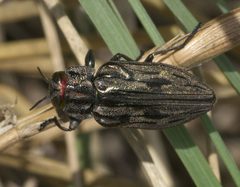
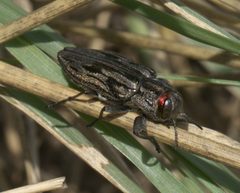
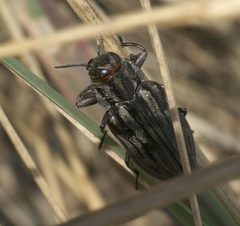
Chrysobothris quadrilineata is a robust metallic wood-boring beetle in the Buprestidae, described by LeConte in 1860 from New Mexico. The is distinguished by its large size relative to , broad and distinct elytral and pronotal ridges, and association with Juniperus plants. It has been recorded from the western United States including Arizona, Nevada, California, Texas, Colorado, Oregon, South Dakota, and Utah, with a notable northeastern range extension to Oklahoma documented in 2013.
Pronunciation
How to pronounce Chrysobothris quadrilineata: //ˌkraɪsəˈbɒθrɪs ˌkwɒdrɪlaɪˈneɪtə//
These audio files are automatically generated. While they are not always 100% accurate, they are a good starting point.
Identification
are robust and larger than the common C. ignicollis, which occurs in similar . The broad, distinct elytral and pronotal ridges are key distinguishing features. The can be confused with C. texana, another western Juniperus associate, but differs in its more robust body and more pronounced ridges.
Images
Habitat
Associated with juniper woodlands, particularly areas with dead branches on live Juniperus trees. In Oklahoma, found on barren flats with scattered eastern red-cedar (Juniperus virginiana).
Distribution
Western North America: New Mexico (type locality), Arizona, Nevada, California, Texas, Colorado, Oregon, South Dakota, Utah, and Oklahoma (Major County, Gloss Mountains State Park—new state record, 2013).
Seasonality
active in early June in Oklahoma; peak activity likely in late spring based on collection timing.
Host Associations
- Juniperus virginiana - first reported ; adults beaten from dead branches on live trees
- Juniperus virginiana - larval first reported larval ; emerged from dead branches collected September 2012
- Juniperus californica - previously recorded in literature (Linsley & Ross 1940)
- Juniperus deppeana - as J. pachyphloea; recorded by Barr & Westcott 1976
Life Cycle
Larvae develop in dead branches of juniper . In Oklahoma, larvae were observed in dead branches with characteristic jewel beetle workings; emerged from branches collected in September and reared to .
Behavior
are found on dead branches of live trees and can be collected by beating branches onto a sheet. In cool, moist conditions, adults may be less active and easier to collect.
Ecological Role
Larval development in dead juniper branches contributes to wood decomposition and nutrient cycling in juniper woodland .
Similar Taxa
- Chrysobothris ignicollisMuch smaller commonly associated with Juniperus in the Great Plains; C. quadrilineata is notably larger and more robust with broader ridges
- Chrysobothris texanaAnother western Juniperus associate; C. quadrilineata differs in more robust body and broader, more distinct elytral and pronotal ridges
More Details
Taxonomic history
Described by LeConte in 1860 from New Mexico. Recorded in early 20th century from Arizona, Nevada, and California. More recently found across western U.S. including Texas (Barr & Westcott 1976), Colorado, Oregon, South Dakota (Nelson et al. 1982), and Utah (Nelson 1987). Oklahoma record (2013) represents significant northeastern range extension.
Collection significance
The 2013 discovery at Gloss Mountains State Park, Oklahoma represented both a new state record and a northeastern range extension for the . The find was part of a productive collecting trip that also yielded new state records for Chrysobothris octocola and Plionoma suturalis.