
Brachys
Dejean, 1833
Leaf-mining jewel beetles
Species Guides
13- Brachys aerosus(Northern Red Oak Jewel Beetle)
- Brachys aeruginosus
- Brachys barberi
- Brachys cephalicus
- Brachys fasciferus
- Brachys floccosus
- Brachys floricola
- Brachys howdeni
- Brachys ovatus(Oval Jewel Beetle)
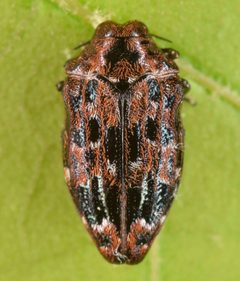
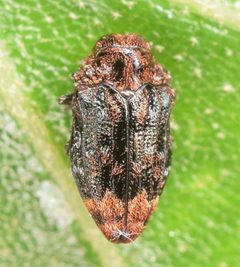
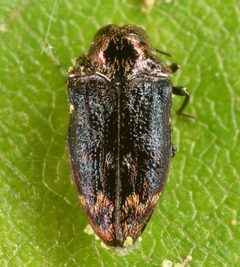
Brachys is a of small metallic wood-boring beetles in the Buprestidae, tribe Trachyini. The genus contains at least 140 described distributed primarily in North America, with some species in Central and South America. are characterized by their flattened, compact, wedge-shaped —distinctly different from the more typical elongate, cylindrical form of most jewel beetles. This body plan reflects their unique larval habit of mining within leaves of plants rather than boring through wood. The genus is strongly associated with oaks (Quercus) and other hardwoods, though some species utilize diverse host plant families.
Pronunciation
How to pronounce Brachys: /ˈbræ.kɪs/
These audio files are automatically generated. While they are not always 100% accurate, they are a good starting point.
Identification
Brachys are distinguished from other Buprestidae by their small size (typically 3–5 mm, with some species reaching slightly larger), flattened and wedge-shaped body form, and compact profile. They differ markedly from elongate cylindrical buprestids like Agrilus or Chrysobothris. Within the , species identification relies on subtle characters including: size variation; color and pattern of elytral (ranging from bronze to gold to silver); presence or absence of marginal bands of pubescence; and details of abdominal sternal pubescence. For example, B. ovatus has a dense row of long hairs along the apex of the last abdominal sternum and a white-margined band of bronze pubescence before the elytral apex, while B. aerosus typically shows basal elytral regions with purple, blue, or green luster and predominantly gold to bronze pubescence. B. aeruginosus is smaller with predominantly light gold to silver apical setae.
Images
Habitat
Brachys inhabit forested and woodland environments where their plants occur. They are strongly associated with oak-dominated including deciduous forests, oak woodlands, and savannas. Some species occupy more specialized habitats such as xeric dolomite prairie remnants (glades) with post oak woodlands, riparian corridors with sycamore, and sand dune with shrubby oaks. The shows affinity for areas with abundant hardwood foliage, particularly where oaks are present in sufficient to support leaf-mining larval .
Distribution
The Brachys has a primarily North American distribution, with documented from the eastern United States through the Midwest, Great Plains, and southwestern states including Texas, New Mexico, and Arizona. Some species extend into Mexico. The genus also occurs in Central and South America, with at least one newly described species from Brazil (B. cleidecostae). Specific distribution patterns vary by species: B. ovatus occurs throughout Missouri and the eastern/midwestern United States; B. aerosus has a broad distribution across eastern and central North America; B. querci and B. cephalicus occur in western Texas and Arizona; B. barberi is found in sand dune of Texas, New Mexico, and Oklahoma; B. rileyi occurs in the Sacramento Mountains of New Mexico; and B. apachei is known from the Chiricahua Mountains of Arizona.
Seasonality
Brachys are active primarily during spring and early summer, with activity periods varying by latitude and elevation. In Missouri, adults are encountered from spring through early summer. In Texas and the Southwest, activity peaks in May and early June, with some persisting into June at higher elevations. The shows strong phenological synchronization with plant budbreak—adult and activity are closely tied to the timing of new leaf flush on oaks and other hardwoods. This association with budbreak directly affects adult distribution patterns on host plants.
Diet
feed on plant foliage, with observations of feeding damage on leaves of oaks and other hardwoods. Larvae are leaf miners, developing within the leaf tissue of host plants.
Host Associations
- Quercus (oaks) - primary larval ; feeding and oviposition siteStrongest and most consistent association across the ; includes multiple oak in both 'white oak' and 'red oak' groups
- Quercus laevis (turkey oak) - larval Documented for B. tessellatus; budbreak affects distribution patterns
- Quercus havardii (shin oak) - larval for B. barberi in sand dune of Texas, New Mexico, and Oklahoma
- Quercus gambelii (Gambel's oak) - larval Target for B. rileyi in New Mexico; also utilized by other Brachys
- Quercus arizonica (Arizona white oak) - larval for B. cephalicus, B. floccosus, and other in Arizona
- Quercus emoryi (Emory oak) - larval for B. cephalicus in Arizona
- Quercus grisea (gray oak) - larval for B. querci in western Texas and Arizona
- Quercus hypoleucoides (silverleaf oak) - larval for B. apachei and B. floccosus in Arizona; less productive for some other
- Platanus wrightii (western sycamore) - larval Unusual record for some Brachys in Arizona
- Alibertia sessilis (Rubiaceae) - larval First record of Brachys associated with Rubiaceae; for B. cleidecostae in Brazilian Cerrado
- Ulmus (elm) - association; possible larval B. aerosus frequently collected on elm; larval utilization uncertain
- Carya (hickory) - association; possible larval Literature reports of mining; veracity questionable according to modern sources
- Fagus (beech) - association; possible larval Older literature reports; may represent incidental associations rather than true larval
- Celtis (hackberry) - association occasionally collected
Life Cycle
Brachys has a complete with , larva, pupa, and stages. Eggs are deposited on plant foliage. Larvae are leaf miners, feeding within the leaf tissue and creating characteristic mines. The stages develop entirely within the leaf, with larvae consuming internal leaf tissue between the upper and lower . occurs within the leaf mine or in the soil. The larval habit of leaf mining—rather than the wood-boring habit typical of most Buprestidae—is a distinctive feature of the tribe Trachyini to which Brachys belongs. Development timing is closely tied to host plant , particularly budbreak and leaf flush.
Behavior
are and active on plant foliage during spring and early summer. They exhibit characteristic of the tribe Trachyini, including a tendency to drop from vegetation when disturbed and fly to nearby branches. When using beating sheets for collection, adults often dash off the sheet quickly, requiring rapid collection technique. Adults are frequently encountered by sweeping or beating the foliage of host plants, particularly the upper branches. Some show strong fidelity to oaks with newly flushed foliage, with adult distribution patterns directly influenced by variation in host plant budbreak .
Ecological Role
As leaf miners, Brachys larvae contribute to herbivore diversity and nutrient cycling in forest . Their specialized feeding strategy places them in a distinct from the wood-boring buprestids, allowing coexistence with other jewel beetle . The association with oak-dominated makes them components of the rich supported by these ecosystems. Their sensitivity to plant suggests potential role as indicators of climate-driven shifts in plant-insect interactions.
Similar Taxa
- MastogeniusSmall size and compact form similar to Brachys, but Mastogenius are even smaller (around 2 mm), more rounded, and lack the distinctly wedge-shaped profile of Brachys
- TaphrocerusMember of same tribe Trachyini with leaf-mining larvae; distinguished by association with sedges (Cyperaceae) rather than hardwoods, and by more elongate body form
- PachyschelusMember of same tribe Trachyini with leaf-mining larvae; distinguished by herbaceous plant associations (primarily Fabaceae) and different
- AgrilusCommon buprestid with some oak-associated ; distinguished by elongate cylindrical body form and wood-boring rather than leaf-mining larvae
- AcmaeoderaSmall buprestids often found on flowers and foliage; distinguished by more convex body form, frequent flower-visiting , and wood-boring or root-boring larvae rather than leaf miners
Sources and further reading
- BugGuide
- Wikipedia
- GBIF taxonomy match
- iNaturalist taxon
- NCBI Taxonomy
- Catalogue of Life
- List of Species Fact Sheets| Grasshoppers of Wyoming and the West
- Grasshoppers of Colorado
- Brachys on oak | Beetles In The Bush
- Acanthaceae | Beetles In The Bush
- A New Species ofBrachysDejean, 1833 (Coleoptera: Buprestidae) from the Eastern United States Using an Unusual Host
- Morphology of the adult and immatures of a striking new species of leaf-mining Brachys Dejean from Brazil (Buprestidae, Agrilinae)
- Variation in budbreak phenology affects the distribution of a leafmining beetle (Brachys tessellatus) on turkey oak (Quercus laevis)
- Taxonomic revalidation of Selenobrachys Schmidt, 1999 and Chilocosmia Schmidt & von Wirth, 1992 based on morphological and molecular analyses (Araneae, Theraphosidae), with the description of a new species from Romblon Island, Philippines.