
Agrilus auroguttatus
Schaeffer, 1905
Goldspotted Oak Borer
Agrilus auroguttatus, the goldspotted oak borer, is a jewel beetle native to southeastern Arizona that became in southern California around 2004. In California, it has caused extensive mortality in oak forests, killing an estimated 80,000 trees, primarily affecting red oaks. The exhibits significantly higher densities in its invasive range compared to its native range, where it coexists with a more diverse of native borers. It was previously treated as a of Agrilus coxalis but is now recognized as a distinct species.
Pronunciation
How to pronounce Agrilus auroguttatus: /ˈæɡrɪləs ɔːˌroʊɡʌˈteɪtəs/
These audio files are automatically generated. While they are not always 100% accurate, they are a good starting point.
Identification
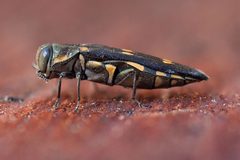
distinguished by combination of dull dark metallic green coloration with three yellow spots per ; D-shaped exit holes approximately 4 mm wide are uniquely diagnostic among California oak subcortical insects. Extremely difficult to distinguish from Agrilus coxalis, which occurs in Mexico and Guatemala; separation requires examination of male genitalia or molecular analysis.
Images
Appearance
is dull dark metallic green, approximately 10 mm long, with three characteristic yellow spots on each forewing (). Larva is white, legless, and reaches 18 mm in length. Adults produce D-shaped exit holes approximately 4 mm wide on the outer bark of trees.
Habitat
Oak woodlands and mixed oak-pine forests in Mediterranean climate zones of southern California and semi-arid mountain ranges of southeastern Arizona. In California: elevations 900–1800 m with hot summers, winter precipitation, rocky well-drained sandy loam soils. In Arizona: elevations 1400–1750 m in semi-arid conditions. Larval development occurs in phloem and wood of lower main stem (bole) of oak trees.
Distribution
Native to mountain ranges in southeastern Arizona (Coronado National Forest). in southern California, first detected in 2004 at Cuyamaca Rancho State Park; confirmed as cause of oak damage in 2008. Current centered in Cleveland National Forest, San Diego County, with expansion to six of seven southernmost California counties. Modeled environmental suitability indicates potential for establishment in northern Sierra Madre Occidental and northwestern Mexican Plateau.
Seasonality
captured in from May through mid-October, with peak flight activity July through August. Pupae and or mature adults present within trees from April through August. present throughout most of the year. time likely one year for majority of individuals, though possibly longer or shorter for some.
Diet
Phloem and wood of oak trees (Quercus spp.), feeding in subcortical tissues of the lower main stem (bole).
Host Associations
- Quercus kelloggii - primary California black oak, Section Lobatae; most affected in California
- Quercus agrifolia - primary coast live oak, Section Lobatae; preferred for seasonal development studies
- Quercus emoryi - Emory oak, Section Lobatae
- Quercus hypoleucoides - silverleaf oak, Section Lobatae
- Quercus chrysolepis - canyon live oak, Section Protobalanus; exhibits similar densities to red oaks despite taxonomic intermediate position
- Quercus engelmannii - Engelmann oak, Section Quercus; colonized at very low densities
Life Cycle
Development occurs in phloem and wood of lower bole. Four larval instars identified based on peristoma measurements. Prepupal mortality increases significantly from winter (3%) to spring (36%). holes indicate completion of development. Recently dead trees (died within 1–3 years) sampled for studies.
Behavior
Occurs most frequently in lower portion of stem (≤1.52 m). Exit hole densities greater at root collar than at mid-boles. patterns on lower boles random at low densities, aggregated at high densities. activity peaks mid-summer.
Ecological Role
Primary biotic agent causing tree mortality in southern California oak forests. As , may alter native borer structure; in California, significantly outnumbers native borers on red oaks (9.6±0.7 versus 4.5±0.6 holes per 0.09 m²). Extensive tree mortality increases wildfire risk in fire-prone region. Native borer community in Arizona includes diverse Buprestidae and Cerambycidae that may be affected by competitive interactions.
Human Relevance
Major forest pest causing significant economic and ecological damage in southern California, with approximately 80,000 trees killed. Dead trees increase wildfire hazard. Management recommendations include avoiding transport of oak firewood to prevent spread. Subject of research, though candidate agents (including Pyemotes tritici mite) have limitations. US Forest Service advises containment guidelines similar to those for emerald ash borer and bronze birch borer.
Similar Taxa
- Agrilus coxalisExtremely similar ; previously treated as (A. coxalis auroguttatus). Occurs in Mexico and Guatemala. Separation requires genitalia examination or molecular analysis.
- Agrilus planipennisEmerald ash borer; similar as Agrilus pest of woody plants, but attacks Fraxinus (ash) rather than Quercus, and occurs in eastern North America.
- Agrilus anxiusBronze birch borer; similar as native Agrilus pest that attacks living trees, but specializes on Betula (birch).
Misconceptions
Originally misidentified as Agrilus coxalis when first detected in California; early tree mortality attributed to drought stress until surveys revealed damage. Early estimate of 15,000 trees killed was later corrected to 80,000.
More Details
Taxonomic History
Originally described as Agrilus coxalis auroguttatus Schaeffer, 1905; elevated to rank as Agrilus auroguttatus. Much literature prior to 2008 refers to it by the synonym A. coxalis or A. coxalis auroguttatus.
Population Density Patterns
In California, densities on red oaks average 9.6±0.7 holes per 0.09 m², versus 0.9±0.2 in native Arizona range. This 10-fold difference suggests release from natural enemies or other factors in range.
Sampling Methodology
Three randomly placed 0.09 m² on lower boles provide reliable estimate of exit hole with <25% error from true mean, facilitating survey and monitoring efforts.
Sources and further reading
- BugGuide
- Wikipedia
- GBIF taxonomy match
- iNaturalist taxon
- Catalogue of Life
- A Thousand Questions about TCD | Bug Squad
- The Day That The Beetles Invaded the Bohart | Bug Squad
- A First Class Box of Beetles | Beetles In The Bush
- Two new species of Agrilus from Mexico | Beetles In The Bush
- A flower visiting jewel beetle that is not an Acmaeodera | Beetles In The Bush
- Densities of Agrilus auroguttatus and Other Borers in California and Arizona Oaks
- Forest stand composition and impacts associated with Agrilus auroguttatus Schaeffer (Coleoptera: Buprestidae) and Agrilus coxalis Waterhouse in oak woodlands
- Agrilus auroguttatus(Coleoptera: Buprestidae) Seasonal Development withinQuercus agrifolia(Fagales: Fagaceae) in Southern California
- Pyemotes tritici(Acari: Pyemotidae): a parasitoid ofAgrilus auroguttatusandAgrilus coxalis(Coleoptera: Buprestidae) in the southwestern United States of America and southern Mexico
- Collection History and Comparison of the Interactions of the Goldspotted Oak Borer,Agrilus auroguttatusSchaeffer (Coleoptera: Buprestidae), with Host Oaks in Southern California and Southeastern Arizona, U.S.A.
- Agrilus auroguttatus exit hole distributions on Quercus agrifolia boles and a sampling method to estimate their density on individual trees
- Environmental suitability for Agrilus auroguttatus (Coleoptera: Buprestidae) in Mexico using MaxEnt and database records of four Quercus (Fagaceae) species
- Native and introduced range surveys for egg parasitoids ofAgrilus auroguttatus, an invasive pest of native oaks in California