
Agrilus audax
Horn, 1891
Audacious Elm Agrilus
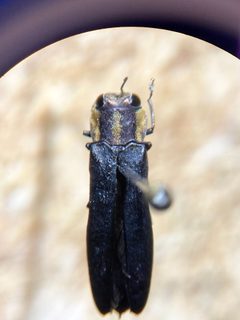
Agrilus audax is a large, striking jewel beetle in the Buprestidae, distinguished by its black and red pronotum with a densely pubescent channel. First described from Texas in 1891, it remained exceptionally rare for over a century, with confirmed records from only a handful of specimens across Texas, Arizona, Missouri, Oklahoma, and Ohio. The is associated with hardwood trees, particularly bur oak (Quercus macrocarpa) and slippery elm (Ulmus rubra), and is considered one of the most elusive North American buprestids.
Pronunciation
How to pronounce Agrilus audax: /ˈæɡrɪləs ˈɔːdæks/
These audio files are automatically generated. While they are not always 100% accurate, they are a good starting point.
Identification
Distinguished from similar Agrilus vittaticollis by prosternal structure: A. audax has normally shaped prosternal sides, while A. vittaticollis has sides bent downward to sharp points. Differs from A. benjamini by structure: A. audax has moderately depressed, uniformly pubescent frons versus deeply depressed frons with restricted to lower half in A. benjamini. Male A. audax identified by deep, smooth, elongate sternal depression, versus obsolete depression in A. benjamini males. Large size and bold black-red coloration separate it from most other Agrilus species.
Images
Appearance
Large-bodied Agrilus with distinctive coloration: black contrasting with bright red pronotum. Pronotum features a densely pubescent channel. with sides normal, not bent downward to sharp points (distinguishing it from A. vittaticollis). moderately depressed and uniformly pubescent. Males possess a deep, smooth, elongate depression on the sternite. Body size and bold color pattern make it visually conspicuous among Agrilus species.
Habitat
Hardwood forests and woodlands; specifically associated with living or recently wind-thrown branches of bur oak (Quercus macrocarpa) and slippery elm (Ulmus rubra). Collected from standing trees and fresh slash piles. specificity contributes to rarity of encounters.
Distribution
North America: documented from Texas (type locality), Arizona, Missouri, Oklahoma, and Ohio. Illinois record exists but remains unconfirmed. Distribution appears discontinuous and patchy, reflecting both genuine rarity and specialized requirements.
Seasonality
active during summer months; specific poorly documented due to scarcity of records. July-August collecting trips in Arizona and New Mexico suggest peak activity during monsoon season in southwestern portion of range.
Host Associations
- Quercus macrocarpa - larval bur oak; larvae develop in living or recently wind-thrown branches
- Ulmus rubra - larval slippery elm; first documented for the
Behavior
have been collected by beating branches of trees. Larvae are wood-borers, developing in living or recently damaged hardwood branches. Specific such as mating, , or host-finding remain undocumented due to extreme rarity of observations.
Ecological Role
Primary consumer as larva, acting as wood-borer in living hardwood branches; contributes to nutrient cycling and structural heterogeneity in oak-elm woodland . Specific ecological interactions remain unstudied.
Human Relevance
Of interest to coleopterists and buprestid as one of North America's rarest and most sought-after jewel beetles. Historical misidentifications, including one by renowned entomologist Josef Knull, illustrate challenges of recognition in this group. No economic or medical significance documented.
Similar Taxa
- Agrilus vittaticollisShares large size and black-red color pattern; distinguished by prosternal sides bent downward to sharp points, versus normal sides in A. audax
- Agrilus benjaminiSimilar coloration and body form; distinguished by deeply depressed with only on lower half, and males with obsolete sternal depression
Misconceptions
Josef Knull, prominent North American coleopterist, misidentified two specimens of A. audax as A. vittaticollis in 1949 and 1953—after having correctly reported the from Missouri. This illustrates that even experienced can overlook rare species, and that A. audax may be underreported due to such misidentifications.
More Details
Rarity and collection history
Known from fewer than 20 specimens total across all collections as of 2010. First described by Horn in 1891 from Texas. Chamberlin's 1926 records from Arizona and Illinois were regarded skeptically by Fisher (1928). Knull's 1934 Missouri record from slippery elm was the first well-documented occurrence outside Texas. Subsequent records from Oklahoma (1990) and additional Missouri localities (1991, 2003) gradually expanded the known range. Kyle Schnepp's 2010 discovery of Knull's misidentified Ohio specimens represents the easternmost confirmed record.
Taxonomic significance
Belongs to a small group within Agrilus characterized by large size, black , and red pronotum with pubescent channel. This group includes A. vittaticollis (common), A. benjamini (uncommon), and A. audax (rarest), forming a gradient of abundance that may reflect ecological specialization or historical factors.