
Agrilus vittaticollis
(Randall, 1838)
Hawthorn Root Borer
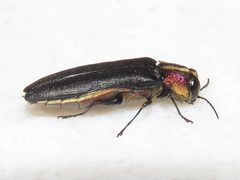
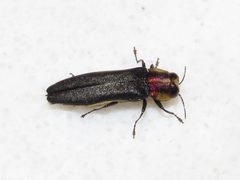
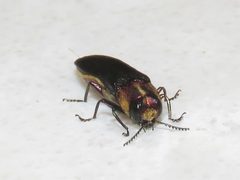
Agrilus vittaticollis, commonly known as the hawthorn root borer, is a metallic wood-boring beetle in the Buprestidae. It is one of several larger, more conspicuous Agrilus characterized by a red pronotum and black . The species develops in living rather than dead plants, specifically in serviceberry (Amelanchier). It is found in North America but is not commonly encountered compared to many other Agrilus species.
Pronunciation
How to pronounce Agrilus vittaticollis: /ˈæɡrɪləs vɪˌtætɪˈkɒlɪs/
These audio files are automatically generated. While they are not always 100% accurate, they are a good starting point.
Identification
Agrilus vittaticollis belongs to a small group of similar-looking Agrilus distinguished by large size (relative to the ), black , and red pronotum with a densely pubescent channel. It is most similar to Agrilus audax and Agrilus benjamini. A key diagnostic feature is the : in A. vittaticollis, the sides are bent downward to sharp points, whereas in A. audax the sides are normal and not bent downward. A. benjamini males have only an obsolete depression on the sternite, while A. audax males have a deep, smooth, elongate depression. Examination of facial and characters is required for definitive identification.
Images
Habitat
Associated with serviceberry (Amelanchier) plants. Larvae mine the lower trunks, crown, and main roots of living host plants rather than dead wood.
Distribution
North America. Records include Ontario and British Columbia in Canada, and presumably the United States though specific states are not detailed in available sources.
Diet
Larval development occurs in living serviceberry (Amelanchier) plants. have been observed on foliage of plants.
Host Associations
- Amelanchier - larval serviceberry; larvae mine living trunks, crowns, and main roots
Life Cycle
Behavior
are found on foliage of larval plants. The is not routinely encountered, likely due to the difficulty of rearing from living hosts compared to species that develop in dead wood.
Similar Taxa
- Agrilus audaxSimilar large size, black , and red pronotum with densely pubescent channel; distinguished by with normal sides not bent downward to sharp points, and male sternite with deep smooth elongate depression
- Agrilus benjaminiSimilar large size, black , and red pronotum with densely pubescent channel; distinguished by deeply depressed and pubescent only on lower half, and male sternite with only obsolete depression
- Agrilus fuscipennisSimilar size and color pattern (red pronotum, black ), but associated with persimmon (Diospyros virginiana) rather than serviceberry
More Details
Taxonomic history
The was originally described as Buprestis vittaticollis by Randall in 1838 before being transferred to Agrilus.
Rarity and collection
Despite being the most common member of its group, A. vittaticollis is still not as frequently encountered as many other Agrilus species. This is attributed to its development in living tissue, making it more difficult to rear than species that develop in dead wood.
Sources and further reading
- BugGuide
- Wikipedia
- GBIF taxonomy match
- iNaturalist taxon
- NCBI Taxonomy
- Catalogue of Life
- Josef Knull was wrong! | Beetles In The Bush
- Agrilus fuscipennis on Persimmon | Beetles In The Bush
- Two new species of Agrilus from Mexico | Beetles In The Bush
- A flower visiting jewel beetle that is not an Acmaeodera | Beetles In The Bush