
Ptinus raptor
Sturm, 1837
eastern spider beetle
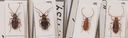
Ptinus raptor, commonly known as the eastern spider beetle, is a of spider beetle in the Ptinidae. It belongs to the Ptinus, a group of beetles often associated with stored products and dry organic materials. The species was first described by Sturm in 1837. Like other spider beetles, it has a rounded, compact body with long legs that give it a spider-like appearance.

Pronunciation
How to pronounce Ptinus raptor: //ˈtaɪ.nəs ˈræp.tɔːr//
These audio files are automatically generated. While they are not always 100% accurate, they are a good starting point.
Identification
Identification to within Ptinus requires examination. P. raptor can be distinguished from congeneric species through detailed morphological analysis, particularly of male genitalia and the structure of antennal segments. The eastern spider beetle is one of several Ptinus species with established in both Europe and North America. Accurate identification should be confirmed through reference to taxonomic keys or expert determination.
Images
Habitat
Spider beetles in the Ptinus are typically found in association with dry organic matter, including stored food products, dried plant material, animal remains, and bird or mammal nests. They occupy indoor environments such as warehouses, granaries, museums, and domestic settings, as well as natural including caves, hollow trees, and rodent burrows. Specific microhabitat preferences for P. raptor are not separately documented from .
Distribution
Ptinus raptor has been recorded from Europe and Northern Asia (excluding China) and North America. The appears to have a transatlantic distribution, likely facilitated by human commerce. GBIF records indicate presence in Belgium, though some Belgian records are marked as absent, suggesting possible misidentification or transient establishment. The distribution overlaps with that of other widespread Ptinus species, complicating range mapping without verified specimens.
Ecological Role
As a member of the , P. raptor contributes to the decomposition of dry organic matter. Spider beetles play a role in nutrient cycling within stored product and natural settings with accumulated dry . Their presence in bird and mammal nests suggests participation in nest through removal of debris, feathers, and other organic material.
Human Relevance
Ptinus , including P. raptor, are recognized as pests of stored products. They can infest dried foods, museum specimens, herbarium collections, and other materials of human value. may cause economic damage through and consumption of stored goods. Management requires control of humidity, removal of food sources, and appropriate storage practices. The 'eastern spider beetle' reflects its significance as a pest in eastern North American contexts.
Similar Taxa
- Ptinus furAnother widespread spider beetle with similar size, coloration, and preferences; requires genital examination for reliable separation
- Ptinus tectusAustralian spider beetle, introduced to many regions, with overlapping stored product pest ; distinguished by antennal and genitalic characters
- Niptus hololeucusGolden spider beetle, similar body form and pest status; distinguished by uniformly golden and different antennal structure
More Details
Taxonomic Note
The placement of Ptinus has varied in literature, with some sources placing the in Anobiidae. Current classification recognizes Ptinidae as a distinct family within Bostrichoidea. The epithet 'raptor' refers to the predatory appearance given by the long legs, not to actual predatory —spider beetles are primarily detritivorous.
Observation Data
iNaturalist records 168 observations of P. raptor, indicating moderate documentation effort, though many spider beetle observations lack -level identification due to the difficulty of field recognition.
Sources and further reading
- BugGuide
- Wikipedia
- GBIF taxonomy match
- iNaturalist taxon
- NCBI Taxonomy
- UC Davis Biodiversity Museum Day: See 'Bird's Eye View' at the Raptor Center | Bug Squad
- Of Raptors and Insects | Bug Squad
- Of Bugs and Plants and Eagles...and More... | Bug Squad
- UC Davis Biodiversity Museum Day: Time to Explore Diversity of Life | Bug Squad
- UC Davis Biodiversity Museum Program: Learning About the Diversity of Life | Bug Squad
- Adults and Kids Can't Wait for UC Davis Biodiversity Museum Day on Feb. 18 | Bug Squad