
Anthrenus fuscus
Olivier, 1789
Mill Carpet Beetle
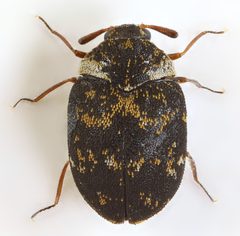
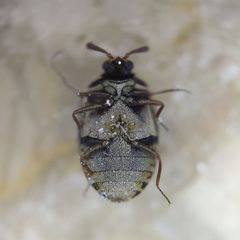
Anthrenus fuscus is a small carpet beetle in the Dermestidae, commonly known as the Mill Carpet Beetle. It occurs in North America and Europe, with in southern Britain showing peak abundance near agricultural areas. are found on flowers during summer months, while larvae feed on dead insects in natural such as spiders' webs and under tree bark. The exhibits sharply defined habitat separation from the closely related A. verbasci.

Pronunciation
How to pronounce Anthrenus fuscus: /ænˈθriːnəs ˈfʌskəs/
These audio files are automatically generated. While they are not always 100% accurate, they are a good starting point.
Identification
are small (2–4 mm), round beetles with patterned . Distinguished from A. verbasci by preferences and distribution patterns; A. fuscus peaks in farm vicinities while A. verbasci dominates suburban southeast England. Often found in association with A. museorum, though in smaller numbers. Larvae feed on dead insects rather than occupying dry birds' nests typical of A. verbasci.
Images
Habitat
Larvae occur in natural including dead insects around spiders' webs and under tree bark. are found on attractive flowers, particularly hogweed (Heracleum sphondylium), during June and July. Shows sharply defined habitat separation from A. verbasci, with very rare cross-habitat occurrence.
Distribution
North America and Europe. In Britain, generally distributed across all locality types in the south with peak abundance near farms; diminish rapidly northward.
Seasonality
active on flowers during June and July.
Diet
Larvae feed on dead insects.
Behavior
sharply defined from A. verbasci; rarely occurs in habitats typical of that . Often accompanied by A. museorum in small numbers.
Human Relevance
Larvae may occur in indoor environments where dead insects accumulate. Less frequently associated with stored products or household damage compared to some .
Similar Taxa
- Anthrenus verbasciOverlapping distribution in Britain but occupies sharply different ; A. verbasci characteristically inhabits dry birds' nests while A. fuscus feeds on dead insects around spiders' webs and under bark. A. verbasci occurs in large numbers only in suburban southeast England, whereas A. fuscus peaks near farms.
- Anthrenus museorumCommonly confused that often accompanies A. fuscus in small numbers in the same and geographic areas.
- Anthrenus polonicusEuropean with similar appearance and overlapping distribution range.
- Anthrenus minutusKnown from Portugal and Spain with similar appearance and overlapping distribution range.
Sources and further reading
- BugGuide
- Wikipedia
- GBIF taxonomy match
- iNaturalist taxon
- NCBI Taxonomy
- What a Micro Moth! | Bug Squad
- A Mural Like No Other | Bug Squad
- This Is NOT an Asian Giant Hornet | Bug Squad
- Bug Eric: Carpet Beetles, Genus Anthrenus
- ID Challenge #9 | Beetles In The Bush
- The Changing Distributions of our Grasshoppers, Crickets and Relatives - Buglife Blog - Buglife
- An Investigation of the Distribution and Field Habits of the Varied Carpet Beetle, Anthrenus verbasci (L.) (Col., Dermestidae) in Britain, with comparative Notes on A. fuscus Ol. and A. museorum (L.)