
Anthrenus museorum
(Linnaeus, 1761)
museum beetle
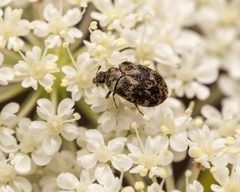
Anthrenus museorum is a small dermestid commonly known as the museum beetle. measure 2–4 mm with round bodies and dark bearing bright colored spots. The larval stage is the primary damaging form, feeding on dry animal materials including skin, hair, feathers, and occasionally dry food products like cheese, flour, or cocoa. The is native to Europe and has become globally distributed through commercial trade, now occurring across the Palearctic, Near East, Nearctic, and other regions including China and Australia. It is a significant pest in museums, where larvae damage taxidermy specimens and insect collections.


Pronunciation
How to pronounce Anthrenus museorum: //ænˈθriːnəs mjuˈseəˌrʌm//
These audio files are automatically generated. While they are not always 100% accurate, they are a good starting point.
Identification
can be distinguished from the commonly confused Anthrenus fuscus by spot pattern and coloration details. From Anthrenus verbasci (varied carpet ), which is more abundant in suburban southeast England, A. museorum occurs in smaller numbers and in association with A. fuscus rather than in dry birds' nests. Adults of A. museorum are found on flowers such as hogweed (Heracleum sphondylium) during June and July, whereas A. verbasci shows stronger association with suburban areas. Larvae of A. museorum are found with A. fuscus in such as under bark and around spiders' webs, not in dry birds' nests typical of A. verbasci. Molecular identification may be necessary as and biological habits are similar to other dermestid beetles.
Images
Habitat
Natural outdoor include areas under tree bark and around spiders' webs where dead insects accumulate. occur on flowers, particularly Apiaceae such as hogweed (Heracleum sphondylium). Indoors, larvae inhabit stored products including animal carcasses, feathers, aquatic products, skin, and medicinal materials. Museum exhibition halls and specimen warehouses, especially insect specimen collections, provide habitat. Females seek nooks, carpets, flooring, or wool for -laying to ensure larval food supply.
Distribution
Native to Europe (Palearctic). Recorded across Europe including Albania, Austria, Belarus, Belgium, Bosnia and Herzegovina, Bulgaria, Croatia, Czech Republic, Denmark, Estonia, Finland, France, Germany, Great Britain, Greece, Hungary, Italy, Kaliningrad, Latvia, Liechtenstein, Lithuania, Luxembourg, Moldova, North Macedonia, Norway, Poland, Portugal, Romania, Russia, Sardinia, Slovakia, Slovenia, Spain, Sweden, Switzerland, Netherlands, Ukraine, Turkey, and former Yugoslavia. Also occurs in the Near East and Nearctic (North America). Globally dispersed through commercial logistics; present in Asia (China), Africa, and Australia. In Britain, occurs in small numbers in southern England, diminishing rapidly northward.
Seasonality
active on flowers during June and July. Adult lifespan outdoors is one to two weeks. Females lay once per year, approximately forty eggs at a time.
Diet
Larvae feed on dry skin and hair of animal origin, including taxidermy specimens, feathers, and furs. Has been observed to occasionally consume dry cheese, flour, or cocoa. In natural , larvae feed on dead insects found in spiders' webs and under bark. feed on pollen, with preference for flowers of Asteraceae, Apiaceae, and Scrophulariaceae.
Host Associations
- Trypoxylus dichotomus - collection site on Specimen collected from this location in China
- Lathroplex anthreni - Ichneumonid that attacks larvae; described from southern Finland based on experimental association
Life Cycle
Female lays approximately forty at a time, once per year. Eggs are deposited in nooks, carpets, flooring, or wool near food sources. Larval stage lasts two to three months under favorable conditions. Entire typically takes 4–12 months depending on temperature and food quality, with warmer temperatures and higher nutrition shortening development time. Some individuals may take more than one year to complete a . occurs after larval feeding period, with emerging in a few weeks.
Behavior
are capable fliers and frequently seek escape to outdoors, often observed on windowsills or in light fixtures. Females actively seek concealed locations with assured food supply for -laying. Larvae are the primary destructive stage. has strong adaptability to various stored products and wide range of harmful effects in storage environments. Often occurs in company with Anthrenus fuscus in both adult and larval stages, with sharply defined differences from A. verbasci.
Ecological Role
Scavenger and decomposer specializing on dry animal remains, particularly keratinous materials (hair, skin, feathers) that few other organisms can digest. In natural , contributes to nutrient recycling of animal remains in late decomposition stages. Serves as for Lathroplex anthreni. stage functions as of some flowers, particularly in spring.
Human Relevance
Significant pest of museum collections, particularly taxidermy specimens of large mammals such as polar bears and big cats, and insect specimen warehouses. Damages woolens, silks, furs, leather, feathers, and carpets in domestic settings. Occasionally infests stored food products including dry cheese, flour, and cocoa. Intercepted during at international ports, posing potential threat to trade. Larval hairs can cause irritation or allergic reactions in sensitive individuals, though this is less documented for A. museorum specifically than for other dermestids. Traditional control methods such as mothballs are ineffective; freezing and thawing cycles or professional dry cleaning are recommended for infested materials.
Similar Taxa
- Anthrenus fuscusCommonly confused ; often found accompanying A. museorum in both and larval stages. Adults similarly found on flowers, larvae under bark and around spiders' webs. Distinguished by specific spot pattern and coloration details on .
- Anthrenus verbasciVaried carpet ; more abundant in suburban areas, characteristically inhabits dry birds' nests rather than bark/spider web . Shows sharply defined habitat difference with very rarely any overlap in typical habitats.
- Attagenus unicolorBlack carpet beetle; larger (3–5 mm), more oval, uniformly jet black, with tapered larvae bearing tuft of long hairs rather than three pairs of posterior structures.
Sources and further reading
- BugGuide
- Wikipedia
- GBIF taxonomy match
- iNaturalist taxon
- NCBI Taxonomy
- Bug Eric: Carpet Beetles, Genus Anthrenus
- Hide and hair, Carpet beetles, Anthrenus sp. — Bug of the Week
- ID Challenge #9 | Beetles In The Bush
- New Analysis Refines Taxonomy of Dermestid Beetles
- Bug Eric: Black Carpet Beetles, Attagenus spp.
- <i>Lathroplex anthreni</i> sp. n. (Hymenoptera, lchneumonidae), a parasitoid on <i>Anthrenus museorum</i> (Linnaeus) in southern Finland
- An Investigation of the Distribution and Field Habits of the Varied Carpet Beetle, Anthrenus verbasci (L.) (Col., Dermestidae) in Britain, with comparative Notes on A. fuscus Ol. and A. museorum (L.)
- The complete mitochondrial genome of Anthrenus museorum (Coleoptera: Bostrichiformia: Dermestidae) from China.