
Lyctus africanus
Lesne, 1907
African powderpost beetle
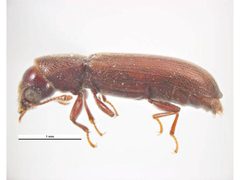
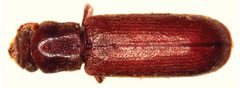
Lyctus africanus is a wood-boring in the Bostrichidae, commonly known as the African powderpost beetle. The is recognized as a significant pest of dry wood, causing damage by converting wood into powdery through larval feeding. It has established across multiple continents including its native Africa, Europe, North America, and Southern Asia. Recent detections in Italy represent its expanding range in the Mediterranean region facilitated by climatic conditions.

Pronunciation
How to pronounce Lyctus africanus: //ˈlɪk.təs æˈfrɪ.kə.nəs//
These audio files are automatically generated. While they are not always 100% accurate, they are a good starting point.
Identification
Powderpost beetles in the Lyctus are distinguished by their ability to reduce infested wood to a fine, powdery . Exit holes from which emerge indicate active . Specific diagnostic characters for L. africanus require microscopic examination; the first Italian record includes illustrations and for identification purposes.
Images
Habitat
Dry wood environments; infests timber used for art crafts and wooden furniture. Associated with wooden materials in tropical and Mediterranean climates where establishment has been documented.
Distribution
Native to Africa; established in Europe (including first record in Italy), North America, and Southern Asia. Not reported from China.
Diet
Wood; larvae digest starchy components of wood, converting them to powdery . Specific wood are documented in literature but not detailed in available sources.
Life Cycle
Larval stage creates damage by tunneling through wood and producing powdery ; emerge through exit holes. Detailed developmental stages not documented in available sources.
Behavior
Both sexes exhibit repulsion to hydrocarbon compounds present in female crude extract, as demonstrated in laboratory preference tests. Male beetles produce involved in chemical communication. Rapid spread through wooden materials has been observed in invaded regions.
Ecological Role
Destructive pest of wooden materials; causing substantial economic losses in forestry and wood products. No native role documented in available literature.
Human Relevance
Significant economic pest of wooden furniture, art crafts, and timber products. Management approaches include chemical treatments, traps for monitoring, and investigation of agents. Early detection and rapid reporting are emphasized for successful management of this .
Similar Taxa
- Other Lyctus speciesShare powderpost beetle characteristics including wood-boring habit and production of powdery ; require microscopic examination for definitive identification
- Other Bostrichidae-level traits of wood-boring ; distinguished by -specific morphological characters
More Details
Invasive Status
First record in Italy (2025) confirms ongoing range expansion in Mediterranean Europe, facilitated by recent climatic conditions favorable to establishment of wood-boring beetles.
Sources and further reading
- BugGuide
- Wikipedia
- GBIF taxonomy match
- iNaturalist taxon
- NCBI Taxonomy
- Catalogue of Life
- Aphytis Project Final Report | Entomology Research Museum
- ID Challenge #22: The Bone Collector | Beetles In The Bush
- Skulls on my desk | Beetles In The Bush
- New fanged dwarf dinosaur from southern Africa ate plants | Blog
- Behavioral changes of powderpost beetle, Lyctus africanus Lesne (Coleoptera: Bostrichidae): responses on female extract
- First record of the invasive powderpost beetle Lyctus africanus Lesne (Coleoptera: Bostrichidae) infesting wooden furniture in Italy