
Clinidium sculptile
Newman, 1838
Carved Slope Beetle
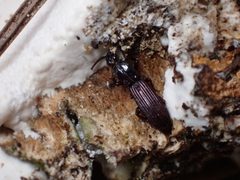
Clinidium sculptile is a small ground beetle in the Rhysodinae, first described by Edward Newman in 1838. It is to the eastern United States, with its range centered on the Appalachian region. The has been documented in association with pitch pine and tulip tree.
Pronunciation
How to pronounce Clinidium sculptile: /klɪˈnɪdiəm ˈskʌlptɪleɪ/
These audio files are automatically generated. While they are not always 100% accurate, they are a good starting point.
Identification
Distinguished from other Clinidium by its specific sculpturing patterns and geographic restriction to the eastern United States. The combination of small size (6.5–7.6 mm), Appalachian distribution, and association with particular trees may aid in field identification, though precise determination requires examination of detailed morphological characters.
Images
Appearance
measure 6.5–7.6 mm in length. As a member of Rhysodinae, it exhibits the characteristic compact, somewhat cylindrical body form typical of the . The name "sculptile" refers to its carved or sculptured appearance.
Habitat
Associated with forested in the Appalachian region. Documented occurrences on pitch pine (Pinus rigida) and tulip tree (Liriodendron tulipifera) suggest a relationship with these tree , though the specific nature of this association remains to be fully characterized.
Distribution
to the eastern United States, primarily in the Appalachian region.
Host Associations
- Pinus rigida - has been recorded onpitch pine
- Liriodendron tulipifera - has been recorded ontulip tree
Similar Taxa
- Other Clinidium speciesMembers of the share the compact body form and subcortical habits; C. sculptile is distinguished by its eastern US distribution and specific associations
More Details
Taxonomic Note
placement varies between sources: treated as Rhysodidae in some classifications (iNaturalist) and as Carabidae: Rhysodinae in others (GBIF, NCBI). The Rhysodinae is consistently recognized across sources.
Conservation Status
With only 4 observations recorded on iNaturalist, this appears to be rarely encountered, though this may reflect specificity, cryptic habits, or limited survey effort rather than rarity per se.