
Clinidium
Kirby, 1830
wrinkled bark beetles
Species Guides
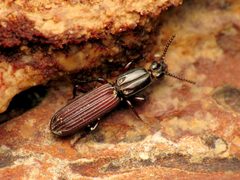
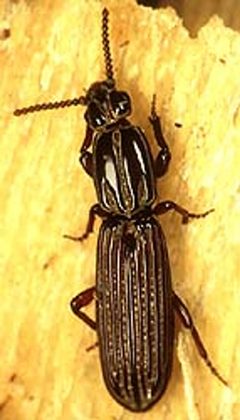
6Clinidium is a of wrinkled bark beetles in the Rhysodinae, characterized by their association with dead and decaying wood. The genus is predominantly Neotropical in distribution, though some extend into North America, with single representatives in Europe (C. canaliculatum) and Japan. Most species are saproxylic, inhabiting rotten wood where they feed on slime moulds. The genus comprises five subgenera and includes species known from Miocene amber deposits.
Pronunciation
How to pronounce Clinidium: //klɪˈnɪdi.əm//
These audio files are automatically generated. While they are not always 100% accurate, they are a good starting point.
Identification
Clinidium are distinguished from other rhysodine by their wrinkled and association with decaying wood. C. canaliculatum is anophthalmic (lacking ), a trait that may be shared with other species in the genus. are , consisting of a scape, , and nine flagellomeres. The genus is distinguished from Rhysodes and Omoglymmius by subtle morphological differences in elytral and body proportions, though specific identification typically requires examination of genitalia and detailed microsculpture.
Images
Habitat
Saproxylic; primarily associated with rotten wood of conifers and other trees. C. canaliculatum inhabits montane forests at elevations around 1,550 m, specifically in old-growth forest with abundant dead wood. The generally requires intact forest with sufficient coarse woody debris.
Distribution
Predominantly Neotropical. Range extends north into North America. Disjunct in Europe (C. canaliculatum in central and southern Italy and Greece) and Japan (one ). C. canaliculatum is known from Sila National Park in Calabria, southern Italy, and mountainous regions of Greece.
Diet
Slime moulds (Myxomycetes). This feeding habit requires specialized mouthpart adaptations for consuming myxomycete colonies present in litter and dead wood.
Life Cycle
Larvae and inhabit rotten wood of conifers. Specific developmental stages and duration are poorly documented for most .
Behavior
C. canaliculatum is anophthalmic and relies heavily on antennal scanning for selection, food location, and mate finding. Seven types of antennal have been identified, including two types of sensilla chaetica, two types of sensilla basiconica, sensilla campaniformia, sensilla coeloconica, and Böhm sensilla. No in antennal has been observed except in the distribution of sensilla coeloconica.
Ecological Role
Obligate saproxylic contributing to biodiversity in old-growth forest . Functions as a consumer of slime moulds within decaying wood microhabitats. Serves as an for intact forest with natural dead wood dynamics.
Human Relevance
C. canaliculatum is listed as vulnerable on the IUCN Red List due to susceptibility to intensive forest management practices that reduce dead wood abundance. Italian have been assessed as Near Threatened. The has value as a bioindicator for conservation monitoring of old-growth forest .
Similar Taxa
- RhysodesBoth are saproxylic wrinkled bark beetles in Rhysodinae, but Clinidium differs in elytral patterns and geographic distribution; Rhysodes sulcatus in Italy is Critically Endangered while C. canaliculatum is Near Threatened.
- OmoglymmiusSimilar preferences and body form, but Clinidium is distinguished by tribal placement (Clinidiini vs. Omoglymmiini) and subtle differences in pronotal and elytral structure; O. germari in Italy is Critically Endangered.
More Details
Subgeneric classification
The contains five subgenera: Clinidium (Mexiclinidium), Clinidium (Protainoa), Clinidium (Tainoa), Clinidium (Arctoclinidium), and Clinidium (Clinidium).
Fossil record
Two are known from Miocene amber deposits, indicating long evolutionary history of the .
Conservation status variation
While C. canaliculatum has shown relatively stable with approximately 50 new sites detected in Sila National Park since 2000, in Europe more severe threats. Population trends appear highly dependent on local forest management practices affecting dead wood retention.
Sources and further reading
- BugGuide
- Wikipedia
- GBIF taxonomy match
- iNaturalist taxon
- NCBI Taxonomy
- Catalogue of Life
- Antennal sensilla in an anophthalmic wood‐dwelling species, Clinidium canaliculatum, Costa 1839 (Coleoptera, Rhysodidae)
- Geographical distribution and conservation status of the threatened saproxylic beetles Rhysodes sulcatus (Fabricius, 1787), Clinidium canaliculatum (O.G. Costa, 1839) and Omoglymmius germari (Ganglbauer, 1891) in Italy (Coleoptera: Rhysodidae)