
Rhysodidae
Wrinkled Bark Beetles
Genus Guides
2- Clinidium(wrinkled bark beetles)
- Omoglymmius
Rhysodidae is a of saproxylic beetles comprising over 350 in approximately 20 , predominantly distributed in tropical forests worldwide. The family contains three European species: Rhysodes sulcatus (Wrinkled Bark Beetle), Clinidium canaliculatum, and Omoglymmius germari. Members are obligate saproxylic beetles dependent on deadwood , with most species being flightless, poorly mobile, and exhibiting cryptic habits. Rhysodes sulcatus is listed as Endangered in the EU-27 and serves as an umbrella species and bioindicator for ancient forest remnants.

Pronunciation
How to pronounce Rhysodidae: //raɪˈsɒdɪdiː//
These audio files are automatically generated. While they are not always 100% accurate, they are a good starting point.
Identification
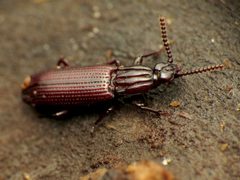
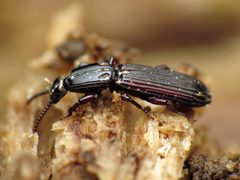
Rhysodidae can be distinguished from other by their highly modified, cylindrical body form adapted for burrowing in wood, with deeply grooved or wrinkled that give the group its . Members possess (bead-like) consisting of a scape, , and nine flagellomeres. Many are anophthalmic (lacking ) or have reduced eyes, reflecting their cryptic, wood-dwelling lifestyle. The family is characterized by seven distinct types of antennal including two types of sensilla chaetica, two types of sensilla basiconica, sensilla campaniformia, sensilla coeloconica, and Böhm sensilla.
Images
Habitat
Primordial, ancient, and old-growth forests with diversified age and structure; mixed beech-silver fir-Norway spruce forests; Central European mountain beech forests, mixed fir forests, and mountain acid forests. Requires abundant large deadwood (minimum 5% wood volume, optimal greater than 15%) in decomposition stages II-III, with individual pieces preferably exceeding 40 cm diameter. Floodplain forests with fallen trees, including those felled by beavers, also support .
Distribution
Worldwide distribution centered in tropical forests, with over 350 globally. In Europe: discontinuous and localized distribution in the Alpine region, with extremely rare and poorly known in temperate zones. Specific confirmed localities include: Biogradska Gora National Park, Bjelasica mountain range, Dinaric Alps, Montenegro; Gran Sasso and Monti della Laga National Park, central Apennines, Italy; Sila National Park, Italy; Pollino National Park, Basilicata, Italy; and Moravia, Czech Republic.
Seasonality
of Rhysodes sulcatus active from mid-June to mid-July; activity pattern documented.
Diet
Specialized feeders on slime mold plasmodia (Myxostelida/Myxomycetes) that grow on deadwood.
Life Cycle
and larvae exhibit cryptic habits within deadwood, found under bark of standing or fallen trees in decomposition stages II-III. Larval development occurs within wood substrate. Specific developmental timing beyond adult activity period not documented.
Behavior
activity; flightless; poorly mobile; strictly bound to decaying wood; cryptic habits of and larvae. True relict of primeval forest conditions, found only in forests not excessively altered by management.
Ecological Role
Saproxylic components of forest involved in fungal decay of wood and nutrient recycling. Serve as umbrella and bioindicators for ecologically well-preserved remnants of ancient forest; presence indicates suitable for conservation of many other saproxylic beetles.
Human Relevance
Included in the EU Directive; Rhysodes sulcatus listed as Endangered (EN) in EU-27 and Critically Endangered (CR) for Italian . Threatened by intensive forest management, habitat loss, and deadwood reduction. Conservation measures recommended include increase of large deadwood masses in forest management practices.
Sources and further reading
- BugGuide
- GBIF taxonomy match
- iNaturalist taxon
- Ant-like Tiger Beetle | Beetles In The Bush
- Distribution of the Rhysodes sulcatus (Fabricius, 1787) and Omoglymmius germari (Ganglbauer, 1892) (Coleoptera: Rhysodidae) in the Czech Republic
- FIRST RECORD OF THE RARE AND THREATENED SAPROXYLIC BEETLE RHYSODES SULCATUS (FABRICIUS, 1787) IN MONTENEGRO (COLEOPTERA RHYSODIDAE) AND IMPLICATION FOR HABITAT CONSERVATION
- Coleotteri saproxilici in Direttiva Habitat del Parco Nazionale del Gran Sasso e Monti della Laga (Appennino centrale) (Coleoptera Rhysodidae, Lucanidae, Cetoniidae, Cerambycidae)
- Coleotteri saproxilici in Direttiva Habitat del Parco Nazionale del Gran Sasso e Monti della Laga (Appennino centrale) (Coleoptera Rhysodidae, Lucanidae, Cetoniidae, Cerambycidae)
- Geographical distribution and conservation status of the threatened saproxylic beetles Rhysodes sulcatus (Fabricius, 1787), Clinidium canaliculatum (O.G. Costa, 1839) and Omoglymmius germari (Ganglbauer, 1891) in Italy (Coleoptera: Rhysodidae)
- Antennal sensilla in an anophthalmic wood‐dwelling species, Clinidium canaliculatum, Costa 1839 (Coleoptera, Rhysodidae)