
Bembidion nigropiceum
(Marsham, 1802)
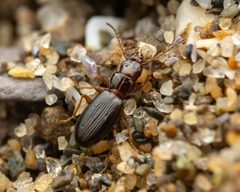
Bembidion nigropiceum is a small, flightless ground beetle native to Europe, introduced to Massachusetts in the late 1800s via ship ballast. It occupies a highly specialized intertidal in coarse gravel at the high-tide line. The was rediscovered in 2007–2008 on Boston Harbor Islands after being presumed extinct in North America since 1897. In Great Britain, it is considered Nationally Scarce and protected under the UK Biodiversity Action Plan due to habitat loss.
Pronunciation
How to pronounce Bembidion nigropiceum: /bɛmˈbi.di.ɔn nɪɡroʊˈpɪ.si.əm/
These audio files are automatically generated. While they are not always 100% accurate, they are a good starting point.
Identification
Distinguished from by its entirely black, non-metallic coloration and short-winged condition. Closely related to Bembidion laticeps. In North America, the only other Bembidion in this specialized intertidal gravel is B. abeillei, which is wing-dimorphic rather than uniformly short-winged.
Images
Habitat
Highly specialized intertidal zone in coarse gravel (pea-size to ping-pong ball diameter) pushed up by seawater at the high-tide line, where sand has been leached out by tidal percolation. Occupies wet interstices within this gravel 'tube' or 'rind', remaining underwater at high tide. In Europe, also found under vegetation thrown up by the sea and in rubble between cracks of coastal cliffs.
Distribution
Native to Europe: England (Kent, Cornwall to northern Suffolk), Wales (Pembrokeshire), Mediterranean coast, and near the English Channel. Introduced to North America: Massachusetts (Boston Harbor Islands: Thompson Island, Grape Island, Rainsford Island), first recorded in late 1800s, rediscovered 2007–2008.
Seasonality
active in spring with peak activity in May. (freshly emerged) adults appear late June through July, indicating period. Active from March to June in Great Britain.
Diet
Presumed of small organisms; likely forages on soft organic matter strained from seawater as it percolates through coarse gravel at high tide.
Life Cycle
-laying, larval development, and occur May–June, with in late June–July. Some adults remain in the gravel mound throughout the season; others move to higher beach areas later in the season. Hibernation occurs in winter. Whether a second or fall activity occurs is unknown.
Behavior
Highly faithful to specialized microhabitat—confined to core of wet, sandless gravel at high-tide line, not found on drier upper beach or seaward zones. Flightless; disperses primarily via drift material. Active forager in wet gravel interstices. Co-occurs with Apristus subsulcatus, which occupies broader beach areas and can fly to escape tides.
Ecological Role
Specialized consumer in narrow intertidal zone; likely contributes to processing stranded marine organic matter in gravel beach .
Human Relevance
Subject of conservation concern in Great Britain due to decline from loss (invasion of Himalayan Balsam, flooding). Protected under UK Biodiversity Action Plan. In North America, represents a rare case of successful establishment by a European carabid transported by ship ballast.
Similar Taxa
- Bembidion laticepsClosely related ; distinguished by specific morphological features not detailed in sources
- Bembidion abeilleiOccurs in similar intertidal gravel in North America; distinguished by being wing-dimorphic rather than uniformly short-winged
- Bembidion brownorumAnother Bembidion with recent rediscovery narrative, but native to California, associated with freshwater creek edges rather than marine intertidal , and has metallic green-gold sheen
More Details
Conservation status
Nationally Scarce in Great Britain; decline attributed to loss from Himalayan Balsam and flooding. Protected under UK Biodiversity Action Plan.
Introduction history
Introduced to Massachusetts in the late 1800s via ship ballast; presumed extinct in North America from 1897 until rediscovery in 2007–2008 on Boston Harbor Islands during All Biodiversity Inventory.
Sources and further reading
- BugGuide
- Wikipedia
- GBIF taxonomy match
- iNaturalist taxon
- NCBI Taxonomy
- Rare beetle, rediscovered after 55 years, named in honor of Jerry Brown
- Rediscovery of Bembidion (Lymnaeum) nigropiceum (Marsham) (= puritanum Hayward) in Massachusetts, with remarks on biology and habitat (Coleoptera, Carabidae, Bembidiini)
- Figures 1–2 from: Davidson R, Ryyken J (2011) Rediscovery of Bembidion (Lymnaeum) nigropiceum (Marsham) (= puritanum Hayward) in Massachusetts, with remarks on biology and habitat (Coleoptera, Carabidae, Bembidiini). ZooKeys 147: 487-496. https://doi.org/10.3897/zookeys.147.2105
- Figure 3 from: Davidson R, Ryyken J (2011) Rediscovery of Bembidion (Lymnaeum) nigropiceum (Marsham) (= puritanum Hayward) in Massachusetts, with remarks on biology and habitat (Coleoptera, Carabidae, Bembidiini). ZooKeys 147: 487-496. https://doi.org/10.3897/zookeys.147.2105
- Figure 4 from: Davidson R, Ryyken J (2011) Rediscovery of Bembidion (Lymnaeum) nigropiceum (Marsham) (= puritanum Hayward) in Massachusetts, with remarks on biology and habitat (Coleoptera, Carabidae, Bembidiini). ZooKeys 147: 487-496. https://doi.org/10.3897/zookeys.147.2105
- Figure 5 from: Davidson R, Ryyken J (2011) Rediscovery of Bembidion (Lymnaeum) nigropiceum (Marsham) (= puritanum Hayward) in Massachusetts, with remarks on biology and habitat (Coleoptera, Carabidae, Bembidiini). ZooKeys 147: 487-496. https://doi.org/10.3897/zookeys.147.2105