
Asaphidion
Gozis, 1886
Species Guides
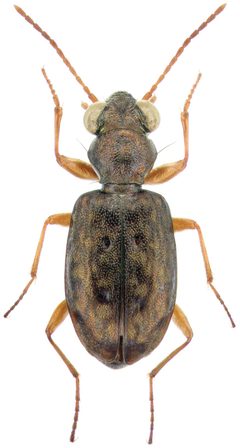
2Asaphidion is a Holarctic of small ground beetles in the Carabidae. The genus contains approximately 39 , predominantly distributed across the Palaearctic region with limited representation in North America. Species are characterized by large and activity patterns. Two native North American species, A. alaskanum and A. yukonense, are restricted to Arctic tundra environments, while the introduced A. curtum has established in the northeastern United States and adjacent Canadian maritime provinces.
Pronunciation
How to pronounce Asaphidion: /ˌæsəˈfɪdiɒn/
These audio files are automatically generated. While they are not always 100% accurate, they are a good starting point.
Identification
External morphological criteria are generally unreliable for distinguishing closely related , particularly within the A. flavipes species group. Genital —specifically spermathecae in females and copulatory pieces of the inner sac in males—provides the only unambiguous identification method for most species. Asaphidion stierlini is an exception where external characters are reportedly sufficient for identification. The may be confused with Elaphrus due to superficial resemblance to tiger beetles, though Asaphidion species are smaller with proportionally larger .
Images
Appearance
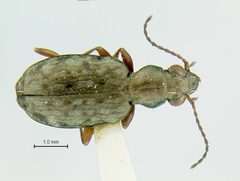
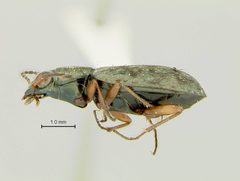
Small ground beetles with notably large, prominent relative to body size. Body form somewhat flattened and streamlined. Coloration varies among , with metallic or dull coloration reported. External morphological characters are often insufficient for species-level identification within species groups, with genital providing more reliable diagnostic features.
Habitat
associations are poorly documented for most . The two native North American species occupy Arctic tundra environments. European species show eurytopic tendencies with broad habitat . Specific microhabitat preferences remain largely unstudied.
Distribution
Predominantly Palaearctic in distribution, occurring across Europe, the Near East, North Africa, and temperate Asia. Two native in North America (A. alaskanum, A. yukonense) are Arctic-restricted. The introduced species A. curtum occurs in the northeastern United States and adjacent Canadian maritime provinces. Multiple species may co-occur at the same localities.
Seasonality
activity period varies by . Asaphidion stierlini shows main activity from May to July in Germany, with imaginal hibernation reported. Other species likely show spring-summer activity patterns typical of temperate ground beetles, though specific data are sparse.
Diet
on springtails (Collembola) and other tiny, soft-bodied prey. This dietary specialization distinguishes the from more predatory ground beetles.
Life Cycle
Imaginal hibernation has been documented in A. stierlini. Larval stages and complete developmental sequences are poorly described for most . details beyond seasonal activity remain largely unknown.
Behavior
activity pattern. Fast-running locomotion. Good and ability documented in A. stierlini, with range expansion in Germany potentially linked to climate warming. cohabitation has been observed at multiple sites in Europe.
Ecological Role
functioning as a agent of . The ecological impact of this predatory specialization has not been quantified.
Human Relevance
No direct economic importance established. Occasionally encountered by collectors due to superficial resemblance to tiger beetles, leading to misidentification. Range expansion of some may serve as a bioindicator of climate change effects.
Similar Taxa
- ElaphrusStrong superficial resemblance to tiger beetles; both have large and somewhat similar body form, though Elaphrus are generally larger and more robust
- Tiger beetles (Cicindelinae)Similar appearance leading to collector confusion; Asaphidion are smaller with proportionally larger and different ecological habits
More Details
Taxonomic note
The has been variously classified; current placement is in Carabidae: Trechinae: Bembidiini based on Catalogue of Life and recent literature. -level relies heavily on genital characters, making field identification challenging.
Invasion biology
A. curtum is the only documented in North America, with established in the northeastern United States and adjacent Canada. Its native range includes Europe and Africa. The mechanism and timing of introduction remain undocumented.
Sources and further reading
- BugGuide
- Wikipedia
- GBIF taxonomy match
- iNaturalist taxon
- NCBI Taxonomy
- Catalogue of Life
- A First Class Box of Beetles | Beetles In The Bush
- Erstnachweis von Asaphidion stierlini (Heyden, 1880) für Baden-Württemberg und dessen aktuelle Verbreitung in Deutschland (Coleoptera, Carabidae)
- Les Asaphidion du groupe flavipes : Critères d'identification et répartition dans la région Rhône-Alpes. Présence en France d'Asaphidion austriacum Schweiger (Coleoptera Trechidae)