
Anillinus
Casey, 1918
Species Guides
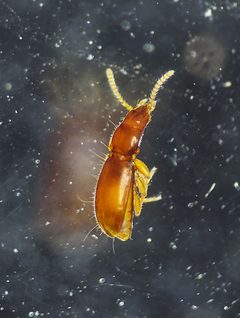
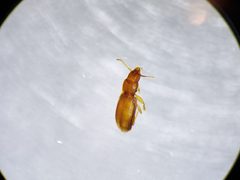
45Anillinus is a of small ground beetles in the Carabidae, comprising more than 60 described primarily from the southeastern United States. Members are blind, wingless, and typically measure 3 mm or less in length. They inhabit deep forest litter, soil, or caves, with many species exhibiting extremely localized distributions. The genus has experienced rapid taxonomic expansion, increasing from 11 known species in 2003 to 63 by 2023, and serves as a valuable model for biogeographic and evolutionary studies of regional biotas.
Pronunciation
How to pronounce Anillinus: /ænɪˈlaɪnəs/
These audio files are automatically generated. While they are not always 100% accurate, they are a good starting point.
Identification
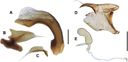
within Anillinus are distinguished primarily by characters of the male genitalia (), with secondary characters including shapes of female spermathecae, body size, and relative proportions of body parts. Species group affiliation can be indicated by microsculpture patterns: for example, loweae-group species lack microsculpture on paramedian areas of the head. Identification to species level requires examination of genitalic structures and often geographic provenance.
Images
Appearance
Small beetles, typically 3 mm long or less. Body form adapted for subterranean and litter-dwelling habits. absent; wingless. Specific morphological characters vary by group; for example, the loweae-group exhibits paramedian areas without microsculpture on the .
Habitat
Deep forest litter, under rocks, soil (endogean ), and caves (troglobitic). Habitat preference varies among , with some groups specialized for subterranean environments while others occupy surface litter layers.
Distribution
Southeastern United States, ranging from the Atlantic coast westward to Texas and Oklahoma. Center of diversity in the southern Appalachian Mountains and adjacent upland terrains. Specific documented localities include Great Smoky Mountains National Park (Tennessee/North Carolina), Alabama (Jackson, Morgan, and Jefferson counties), and the French Broad River region. Two Brazilian (A. magnus and A. minor) have been described but their validity is questioned.
Behavior
constrained by physical barriers; exhibit altitudinal stratification influenced by glacial cycles. Extremely localized distributions suggest limited dispersal capability consistent with wingless, subterranean lifestyle.
Human Relevance
Provides valuable biogeographic information for modeling evolutionary systems of regional biotas. Rapid discovery rate makes the a focal group for studies of recent lineage diversification and speciation mechanisms.
Similar Taxa
- Other Anillina subtribe generaShare blind, wingless, small-bodied ; distinguished by specific genitalic and microsculpture characters, as well as geographic distribution patterns
More Details
Taxonomic expansion
The remains one of the most incompletely known ground beetle genera in the United States, with count increasing nearly sixfold between 2003 and 2023.
Phylogeographic research
COI gene sequences and aedeagal have been used to reconstruct biogeographic history; however, these data sources sometimes yield conflicting phylogenetic results.
Speciation drivers
Major factors affecting speciation include: division of ancestral ranges due to drainage system changes prior to Pleistocene glaciation; Pliocene-Pleistocene climate cooling with constrained by physical barriers; and Early Pleistocene glacial cycles influencing altitudinal stratification.
Sources and further reading
- BugGuide
- Wikipedia
- GBIF taxonomy match
- iNaturalist taxon
- NCBI Taxonomy
- Catalogue of Life
- New species of Anillinus Casey (Carabidae: Trechinae: Bembidiini) from the Southern Appalachians and phylogeography of the A. loweae species group
- New species of Anillinus Casey (Carabidae: Trechinae: Bembidiini) from Great Smoky Mountains National Park, U.S.A. and phylogeography of the A. langdoni species group
- Four new species of the genus Anillinus Casey (Coleoptera, Carabidae, Anillini) from Alabama, U.S.A., with a revised key to the Alabama species
- Figure 3 from: Sokolov IM, Schnepp KE (2021) A new subterranean species of Anillinus Casey (Carabidae, Trechinae, Anillini) from Florida. Subterranean Biology 39: 33-44. https://doi.org/10.3897/subtbiol.39.65769
- Figure 1 from: Sokolov IM, Schnepp KE (2021) A new subterranean species of Anillinus Casey (Carabidae, Trechinae, Anillini) from Florida. Subterranean Biology 39: 33-44. https://doi.org/10.3897/subtbiol.39.65769
- Figure 2 from: Sokolov IM, Schnepp KE (2021) A new subterranean species of Anillinus Casey (Carabidae, Trechinae, Anillini) from Florida. Subterranean Biology 39: 33-44. https://doi.org/10.3897/subtbiol.39.65769
- Figure 1 from: Sokolov IM (2022) Two new cavernicolous species of Anillinus Casey (Carabidae, Trechinae, Anillini) from Texas with a revised key to Texas species. Subterranean Biology 44: 153-166. https://doi.org/10.3897/subtbiol.44.91002
- Figure 3 from: Sokolov IM (2022) Two new cavernicolous species of Anillinus Casey (Carabidae, Trechinae, Anillini) from Texas with a revised key to Texas species. Subterranean Biology 44: 153-166. https://doi.org/10.3897/subtbiol.44.91002
- Figure 4 from: Sokolov IM, Schnepp KE (2021) A new subterranean species of Anillinus Casey (Carabidae, Trechinae, Anillini) from Florida. Subterranean Biology 39: 33-44. https://doi.org/10.3897/subtbiol.39.65769
- Figure 4 from: Sokolov IM (2022) Two new cavernicolous species of Anillinus Casey (Carabidae, Trechinae, Anillini) from Texas with a revised key to Texas species. Subterranean Biology 44: 153-166. https://doi.org/10.3897/subtbiol.44.91002
- Figure 5 from: Sokolov IM (2022) Two new cavernicolous species of Anillinus Casey (Carabidae, Trechinae, Anillini) from Texas with a revised key to Texas species. Subterranean Biology 44: 153-166. https://doi.org/10.3897/subtbiol.44.91002
- Figure 2 from: Sokolov IM (2022) Two new cavernicolous species of Anillinus Casey (Carabidae, Trechinae, Anillini) from Texas with a revised key to Texas species. Subterranean Biology 44: 153-166. https://doi.org/10.3897/subtbiol.44.91002
- Two new species of the genus Anillinus Casey (Coleoptera, Carabidae, Anillini) from the southern United States.