
Amara alpina
(Paykull, 1790)
Amara alpina is an arctic-alpine ground beetle in the Carabidae, first described by Gustaf von Paykull in 1790. It inhabits cold regions at high altitudes and high latitudes across the Holarctic, with in Scandinavia, Siberia, Mongolia, Alaska, and Canada. Molecular genetic evidence indicates that Beringian populations persisted throughout the Pleistocene, while other regions were recolonized following glacial retreat. The has been observed feeding on dead insects on snowfields and is associated with specific alpine vegetation.
Pronunciation
How to pronounce Amara alpina: /əˈmɑːrə ælˈpiːnə/
These audio files are automatically generated. While they are not always 100% accurate, they are a good starting point.
Identification
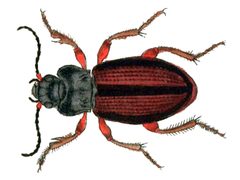
Distinguished from other Amara by its arctic-alpine distribution combined with reddish-black and often red legs. The fine longitudinal striations on elytra and overall dark coloration with reddish accents are characteristic. In North America, it is the only Amara species in this ecological zone; in Europe, it may be confused with other montane Amara species but its strict association with high-latitude or high-altitude cold helps separate it.
Images
Habitat
Cold regions at high altitudes and high latitudes; specifically arctic-alpine environments. In Scandinavia, found on dwarf birch (Betula nana), dwarf willow (Salix herbacea), glacier buttercup (Ranunculus glacialis), alpine bearberry (Arctostaphylos alpina), moss bell heather (Harrimanella hypnoides), crowberry (Empetrum), and arctic wood-rush (Luzula nivalis).
Distribution
Native to northern Europe and Asia. Range includes Norway, Sweden, Finland, Great Britain, Siberia, and Mongolia. In North America: Alaska, Canada (recolonized post-glaciation), northern Appalachian Mountains, and central Rocky Mountains. Beringian represent a long-term Pleistocene refugium.
Diet
Has been observed feeding on dead bodies of other insects on snowfields in Finland. Specific dietary habits otherwise not documented.
Behavior
In Scandinavia, frequently found on specific alpine plant . One of three species observed in Finland consuming dead insects on snowfields.
Ecological Role
Functions as a scavenger in arctic-alpine , evidenced by necrophagous on snowfields. Contributes to nutrient cycling in cold, nutrient-limited environments.
More Details
Phylogeography
Molecular genetic studies reveal significant structure: Beringian populations show highest haplotype diversity, consistent with continuous occupation throughout the Pleistocene. Hudson Bay region populations lack restriction site variation, indicating recent (~6000 years ago) from Beringia. Rocky and Appalachian Mountain populations show intermediate diversity, founded from at least two ancestral haplotypes in a southern refugium.
Sources and further reading
- BugGuide
- Wikipedia
- GBIF taxonomy match
- iNaturalist taxon
- NCBI Taxonomy
- Learning About Bees at the UC Davis Bee Haven | Bug Squad
- Study: More IPM Knowledge Could Help Leafy Amaranth Farmers in East Africa
- Zoologia | Blog
- Hemiptera | Blog
- saproxylic beetles | Blog
- Quick Guide to Armyworms on Soybean | Beetles In The Bush
- Molecular genetic evidence for the post‐Pleistocene divergence of populations of the arctic‐alpine ground beetle Amara alpina (Paykull) (Coleoptera: Carabidae)