
Chlaenius prasinus
Dejean, 1826
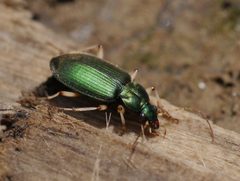
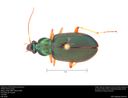
Chlaenius prasinus is a of ground beetle in the Carabidae, characterized by its vivid metallic green coloration. The Chlaenius contains approximately 1,000 species worldwide, with members distributed across the Palearctic, Near East, North Africa, Afrotropical region, and Nearctic. Species in this genus are known for their chemical defense capabilities and predatory habits. C. prasinus has been documented in the United States, though specific ecological details remain limited in published sources.
Pronunciation
How to pronounce Chlaenius prasinus: //ˈkliniəs ˈpræsɪnəs//
These audio files are automatically generated. While they are not always 100% accurate, they are a good starting point.
Identification
Distinguished from other ground beetles by its vivid metallic green coloration combined with (segments longer than wide, not bead-like). Differs from darkling beetles (Tenebrionidae) by exposed and rapid running . Separated from other metallic carabids by the specific shade of green and body proportions. The Chlaenius is further characterized by chemical defense glands that produce aromatic compounds.
Images
Habitat
Ground beetles in the Chlaenius typically occupy moist near water sources, including riparian zones, wetlands, and areas with saturated soils. Specific habitat preferences for C. prasinus are not well documented.
Distribution
Documented from the United States; present in North America. The broader Chlaenius occurs across the Palearctic, Near East, North Africa, Afrotropical region, and Nearctic, with the majority of in the Oriental and Afrotropical regions.
Behavior
Members of the Chlaenius are known to possess chemical defense capabilities, releasing pungent aromatic compounds from abdominal glands when disturbed. They are ground-dwelling and capable of rapid running.
Ecological Role
As a ground beetle, likely functions as a of small . The Chlaenius has been identified as a bioindicator of environmental conditions due to sensitivity to disturbance.
Similar Taxa
- Chlaenius tricolorAnother metallic green Chlaenius found in North American agricultural systems; distinguished by specific color pattern and distribution details
- Chlaenius impunctifronsDocumented for ; similar size and preferences but differs in punctation patterns on
- Darkling beetles (Tenebrionidae)Superficially similar dark, ground-dwelling beetles; distinguished by bead-like , concealed , and slower movement
More Details
Taxonomic Note
The Chlaenius is divided into numerous subgenera, though the subgeneric placement of C. prasinus is not specified in available sources. The was described by Dejean in 1826.
Etymology
The specific epithet 'prasinus' derives from Latin, meaning 'leek-green,' directly referencing the characteristic coloration of this .