
Sericoda
Kirby, 1837
Species Guides
4- Sericoda bembidioides
- Sericoda bogemannii
- Sericoda obsoleta
- Sericoda quadripunctata(Four-spotted Sericoda)
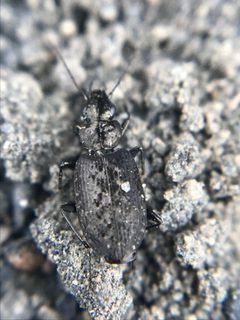
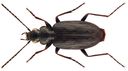
Sericoda is a of harpaline ground beetles native to the Holarctic region, with apparent North American origin. These beetles are pyrophilous, meaning they are strongly attracted to burned areas following forest fires. They are generally smaller than related genera such as Agonum. Two , Sericoda quadripunctata and S. bembidioides, have been extensively studied in forests of Alberta, Canada, where they serve as for phoretic mites of the genus Antennoseius.
Pronunciation
How to pronounce Sericoda: /ˌsɛrɪˈkoʊdə/
These audio files are automatically generated. While they are not always 100% accurate, they are a good starting point.
Identification
Generally smaller than related Agonum, with which they share similar habits. Specific identification features at the genus level are not documented in available sources.
Images
Habitat
Recently burned forests and fire-disturbed , particularly in regions. abundance is positively associated with fire severity and highest in the first post-fire year, declining substantially by the third year.
Distribution
Holarctic region, with apparent origin in North America. Documented in Alberta, Canada; Denmark; Norway; Sweden; and Vermont, USA.
Seasonality
Most abundant during the summer immediately following forest fires; numbers decrease in subsequent years.
Host Associations
- Antennoseius perseus - phoretic mite living under described from Sericoda quadripunctata and S. bembidioides in Alberta, Canada
- Antennoseius pyrophilus - phoretic mite living under described from Sericoda quadripunctata and S. bembidioides in Alberta, Canada
Behavior
Pyrophilous: strongly attracted to burned areas after forest fires. Serves as for phoretic mites that live under the . show differential responses to combined disturbances: Sericoda quadripunctata increases in abundance with wildfire plus forest harvesting, while S. bembidioides decreases.
Ecological Role
Bioindicator for fire disturbance and post-fire in . Potential role in early post-fire .
Human Relevance
Subject of ecological research regarding forest fire management and salvage logging practices. Presence and abundance patterns inform understanding of post-fire and effects of combined natural and anthropogenic disturbances.
Similar Taxa
- AgonumRelated with similar habits; Sericoda are generally smaller
- ElliptoleusCentral American identified as closest living relative, suggesting phylogenetic proximity
Sources and further reading
- BugGuide
- Wikipedia
- GBIF taxonomy match
- iNaturalist taxon
- NCBI Taxonomy
- Catalogue of Life
- Responses of two <i>Sericoda</i> Kirby, 1837 (Coleoptera: Carabidae) species to forest harvesting, wildfire, and burn severity
- Phase morphs and phoresy: New species of Antennoseius (Vitzthumia) mites (Acari: Mesostigmata: Ascidae) associated with pyrophilous carabids (Carabidae: Sericoda spp.) in Alberta, Canada