
Sericoda quadripunctata
(DeGeer, 1774)
Four-spotted Sericoda
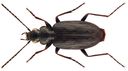
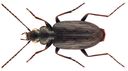
Sericoda quadripunctata is a pyrophilous ground beetle strongly associated with recently burned forests in regions. Its abundance peaks in the first year after wildfire and declines sharply by the third post-fire year. The serves as a phoretic for specialized mites (Antennoseius perseus and A. pyrophilus) that inhabit the space beneath its . It occurs across the Holarctic region, including Europe, Northern Asia, and North America.
Pronunciation
How to pronounce Sericoda quadripunctata: /sɛˈriːkoʊdə ˌkwɒdrɪˌpʌŋkˈtɑːtə/
These audio files are automatically generated. While they are not always 100% accurate, they are a good starting point.
Identification
Distinguished from by association with post-fire ; S. bembidioides is sympatric but shows opposite response to forest harvesting (lower catches where S. quadripunctata shows higher catches). Specific morphological diagnostic features not available from sources.
Images
Habitat
Recently burned forests in regions; post-fire sites. Abundance positively associated with fire severity.
Distribution
Holarctic: Europe, Northern Asia (excluding China), North America. Documented in Alberta (Canada), Alaska (USA), Austria, Belgium, and Bhutan.
Seasonality
Most abundant in first post-fire year; abundance decreases drastically by third post-fire year.
Host Associations
- Antennoseius perseus - phoretic mite inhabits space under described from specimens collected from this in Alberta, Canada
- Antennoseius pyrophilus - phoretic mite inhabits space under described from specimens collected from this in Alberta, Canada; epithet reflects fire association
Life Cycle
Abundance pattern indicates early successional specialization; peaks immediately post-fire and declines within three years.
Behavior
Pyrophilous (fire-adapted); exhibits strong attraction to recently burned . Serves as phoretic for mites, which use the for to new burn sites.
Ecological Role
Bioindicator of post-fire ecological conditions and salvage logging impacts; presence and abundance reflect fire severity and early successional stage of forest .
Human Relevance
Used as study organism for assessing ecological impacts of salvage logging (post-fire removal of burned trees); higher catches in areas with combined wildfire and forest harvesting compared to wildfire alone.
Similar Taxa
- Sericoda bembidioidesSympatric with opposite response to forest harvesting (lower catches where S. quadripunctata increases); both are pyrophilous but differ in management sensitivity.
Sources and further reading
- BugGuide
- Wikipedia
- GBIF taxonomy match
- iNaturalist taxon
- NCBI Taxonomy
- Catalogue of Life
- Meloidae Holdings | Entomology Research Museum
- Responses of two <i>Sericoda</i> Kirby, 1837 (Coleoptera: Carabidae) species to forest harvesting, wildfire, and burn severity
- Phase morphs and phoresy: New species of Antennoseius (Vitzthumia) mites (Acari: Mesostigmata: Ascidae) associated with pyrophilous carabids (Carabidae: Sericoda spp.) in Alberta, Canada