
Rhadine caudata
(LeConte, 1863)
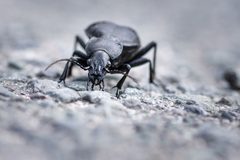
Rhadine caudata is a brachypterous (flightless) ground beetle in the Carabidae. It was first described by John Lawrence LeConte in 1863 as Platynus caudatus and later transferred to Rhadine. The is considered globally Vulnerable by NatureServe, Imperiled in Alabama, and Vulnerable in Virginia. It is widely distributed across the eastern United States but is rare throughout its range, with low capability.
Pronunciation
How to pronounce Rhadine caudata: /ˈreɪdaɪn ˈkɔːdəˌtɑː/
These audio files are automatically generated. While they are not always 100% accurate, they are a good starting point.
Identification
Images
Habitat
Forest ; occurs in only two of five forest classes in a North Carolina study. Occupies both surface and subsurface (cave/groundwater) environments.
Distribution
Eastern United States from Texas to the Atlantic coast, north to Wisconsin. Documented from Alabama, Arkansas, District of Columbia, Georgia, Illinois, Indiana, Kentucky, Maryland, North Carolina, Ohio, Pennsylvania, Tennessee, Virginia, West Virginia, and Wisconsin. Known to be abundant only at Cumberland Caverns and McElroy Cave in Tennessee.
Behavior
Low rate due to flightlessness. Capable of utilizing both surface forest and subsurface cave environments.
Ecological Role
May serve as a biodiversity indicator for forest and cave health. Study of this and may reveal information about the evolution of subterranean life and regressive evolution.
Human Relevance
Conservation concern due to specialization and rarity. Listed as globally Vulnerable by NatureServe. Subject of ecological research regarding cave dynamics and subterranean .
Similar Taxa
- Rhadine exilisBoth are cave-dwelling Rhadine , but R. exilis is restricted to central Texas caves and is federally endangered, whereas R. caudata has a much broader eastern distribution
- Rhadine infernalisBoth are cave-dwelling Rhadine , but R. infernalis is restricted to central Texas caves and is federally endangered, whereas R. caudata has a much broader eastern distribution
- Other Rhadine speciesMost Rhadine are subterranean of the southwestern United States; R. caudata is distinguished by its eastern distribution and use of both surface and subsurface
More Details
Conservation Status
NatureServe ranks: Global - Vulnerable (G3); Alabama - Imperiled (S2); Virginia - Vulnerable (S3). Not federally listed under the U.S. Act, unlike R. exilis and R. infernalis.
Taxonomic History
Originally described as Platynus caudatus by LeConte in 1863; later transferred to Rhadine.
Research Significance
Studying R. caudata and other Rhadine may provide insights into the evolution of subterranean life, regressive evolution, and the use of as biodiversity indicators.
Sources and further reading
- BugGuide
- Wikipedia
- GBIF taxonomy match
- iNaturalist taxon
- NCBI Taxonomy
- Catalogue of Life
- How Entomologists are Battling Invasive Ants to Protect a Texas Cave Ecosystem
- Southernmost crocodile newt record is a threatened new species |
- Simplified method to survey amphibians will aid conservation | Blog
- New to science newts from Vietnam with an important message for Biodiversity Day 2020 | Blog