
Lebia grandis
Hentz, 1830
Large Foliage Ground Beetle
Lebia grandis is a North American ground beetle and the largest in its on the continent. are of Colorado potato beetle and larvae, consuming up to 23 eggs or 3 third-instar larvae daily. First-instar larvae are obligate of Leptinotarsa pupae, developing within pupal chambers in soil. The species has primarily habits and a cryptic that delayed recognition of its ecological importance for approximately a century after its formal description.
Pronunciation
How to pronounce Lebia grandis: /ˈle.bi.a ˈɡran.dɪs/
These audio files are automatically generated. While they are not always 100% accurate, they are a good starting point.
Identification
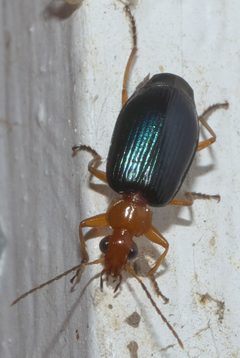
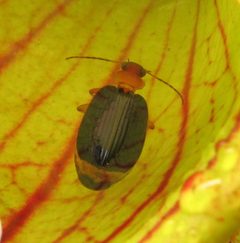
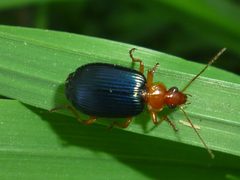
Distinguished from other Lebia by larger size (approximately 10 mm vs. smaller ) and distinctive coloration: rusty orange and contrasting with black and iridescent blue-purple . The protruding abdomen beyond the short elytra is a notable structural feature. Separation from Lebia subgrandis requires careful examination; the latter is native to Mexico and has been studied as a separate candidate. are rarely captured in pitfall traps due to habits, making direct observation more reliable than passive sampling.
Images
Appearance
Approximately 10 mm in length. , , and legs rusty orange. black. dark with iridescent blue or purple lustre, wide but shorter than abdomen, which protrudes posteriorly beyond elytral apices.
Habitat
Associated with potato fields and grazed pastures containing horsenettle (Solanum carolinense). overwinter in soil within or adjacent to potato fields. Females oviposit in soil below -infested plants. Larval development occurs in soil within host pupal chambers.
Distribution
Eastern North America: eastern United States from North Carolina north to Maine, west to Ontario and Quebec in Canada. Not recorded across much of the western range of its primary , Leptinotarsa decemlineata. Historical records from early collection localities predate the eastward expansion of the Colorado potato beetle, suggesting original association with other Leptinotarsa .
Seasonality
overwinter in soil and emerge in spring, several weeks after become active. Reproductive activity continues through summer; early-summer females are more fecund than late-summer females. Adult lifespan 4-5 months. Complete from to adult approximately 5 weeks (2 weeks egg incubation, 3 weeks larval development to adult emergence).
Diet
are of Leptinotarsa and larvae, particularly first through third instars. Adults consume mean of 3.3 third-instar larvae or equivalent of 23.0 Colorado potato beetle eggs per day. First-instar larvae are obligate of Leptinotarsa pupae, feeding ectoparasitically on and pupae within soil chambers.
Host Associations
- Leptinotarsa decemlineata - () and (larva)Colorado potato beetle; primary contemporary
- Leptinotarsa juncta - () and (larva)false potato beetle; presumed original based on historical and superior larval development success (43.6% vs. 11.5% for L. decemlineata)
- Leptinotarsa haldemani - () and (larva)laboratory studies confirm suitability as , though range overlap limited to possibly Texas
Life Cycle
laid singly in soil near plants, camouflaged with adherent soil from glandular secretion; up to 1300 eggs per female over several months. Eggs hatch after approximately two weeks. First-instar larvae actively seek prepupating host larvae in soil, following odor trails to unsealed chambers. Larvae sink into host and feed, killing host; after molting, cease feeding and pupate within chamber. emerge approximately three weeks after egg hatch. First-instar larval lifespan averages 8.3 days.
Behavior
Primarily , rarely appearing in pitfall traps. exhibit escape when disturbed. Naive, newly-emerged adults show no prey preference among Leptinotarsa in laboratory conditions. Adults forage both day and night but are seldom observed due to cryptic habits. Larvae demonstrate active -seeking behavior in soil, using chemical cues to locate unsealed pupal chambers before host is complete.
Ecological Role
Important and of Colorado potato beetle and related chrysomelids. consume more Colorado potato beetle and larvae per day than any other documented predator of this pest. Constrained to potato fields by obligate association with chrysomelid , unlike predators that may disperse to alternative food sources. Potential agent for suppression of Leptinotarsa in diverse agroecosystems, though natural typically insufficient for complete pest control.
Human Relevance
Evaluated as agent for Colorado potato beetle in United States. Native status and specificity are advantageous for regulatory approval. Rearing in bulk presents unresolved difficulties, limiting implementation. Augmentative release of may be required to achieve effective pest suppression. Not considered a nuisance or hazardous ; no defensive of concern to humans documented.
Similar Taxa
- Lebia subgrandisSimilar as and of Colorado potato beetle; distinguished by native range (Mexico vs. eastern North America), activity pattern, and taxonomic status as separate
- Coleomegilla maculataAlso preys on Colorado potato beetle and larvae, but with broader diet and patterns; lacks larval stage and specialization
Misconceptions
The ecological significance of L. grandis was underappreciated for approximately a century after its description due to habits and subterranean larval existence; early were unaware of its life stage. The was long assumed to be exclusively associated with Colorado potato beetle, but historical records from areas lacking this and laboratory studies demonstrate broader host range including other Leptinotarsa species.
More Details
Historical host relationships
Historical collection records from North Carolina and other eastern localities predate the 1850s eastward expansion of Leptinotarsa decemlineata onto potato crops. Research suggests L. grandis was originally associated with L. juncta feeding on horsenettle, with opportunistic expansion onto L. decemlineata following range expansion of the latter . Laboratory studies demonstrate L. juncta is a superior host for larval development.
Biological control potential
L. grandis shows promise as agent due to specificity, high rate, and native status avoiding regulatory complications. However, mass rearing difficulties and typically insufficient natural densities for complete control limit current practical application. are rarely captured in standard pitfall sampling, complicating population monitoring.
Sources and further reading
- BugGuide
- Wikipedia
- GBIF taxonomy match
- iNaturalist taxon
- NCBI Taxonomy
- Guest Blog Post: Researchers split the birdcatcher trees (genus Pisonia) into three | Blog
- Bug Eric: New Mexico Night Bugs
- Bug Eric: Wasp Wednesday: Western Cicada Killer
- Prey preference and host suitability of the predatory and parasitoid carabid beetle, Lebia grandis, for several species of Leptinotarsa beetles
- Biology of Lebia subgrandis Madge, A Natural Enemy of the Colorado Potato Beetle