
Anisodactylus binotatus
(Fabricius, 1787)
common shortspur beetle
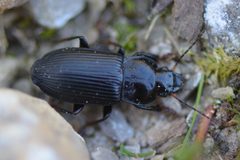
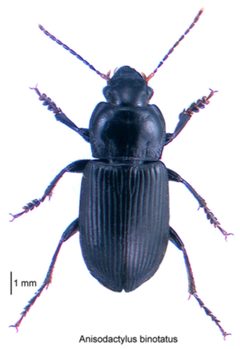
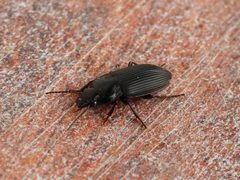
A medium-sized ground beetle native to Europe, introduced to New Zealand in 1938 where it has become widely established. measure 10–12.7 mm with distinctive shiny black coloration and a characteristic red spot (or paired spots) on the between the . The exhibits capability and has proven to be an exceptionally successful colonist, thriving in both natural and anthropogenic including cultivated fields and urban environments.
Pronunciation
How to pronounce Anisodactylus binotatus: /ˌænɪsoʊˈdæktɪləs baɪnoʊˈteɪtəs/
These audio files are automatically generated. While they are not always 100% accurate, they are a good starting point.
Identification
Distinguished from similar ground beetles by the red spot (sometimes two separate spots elongated horizontally) on the between the . The spur on the hind tibia is characteristic of the Anisodactylus. The basal segment of the being twice the length of the second tarsal segment is a key diagnostic feature. -capable, unlike many flightless Carabidae.
Images
Appearance
Shiny black non-metallic polish on , pronotum, , and . Length 10–12.7 mm. Elytra with uniform impressed pattern of small evenly spaced crinkle-like waves; setae present at base, apex, and sides. Tibia and light brown to red-black. Basal segment of tarsus twice length of second segment. First antennal segment red-brown, remaining segments black; reach base of pronotum. Strongly developed, slightly rounded shoulders.
Habitat
Lowland under logs, stones, and plant debris; fields and soil burrows. Associated with moderately moist soil conditions and clay loam soils. Often found near water sources including peat bogs and lake banks. Thrives in anthropogenic habitats: , greenhouses, dumps, and cultivated fields with grass or herbaceous cover.
Distribution
Native to Europe with extensive distribution throughout England, Ireland, Wales, and lowland Scotland; also present in coastal North American states, Portuguese Islands (Azores: Corvo, Faial, Flores, Graciosa, Pico). Introduced to New Zealand in 1938, now established across both islands including Wellington region, Canterbury, Otago Lakes, Central Otago, and Dunedin.
Seasonality
Reproductively active September to April in New Zealand. relatively inactive during colder months, possibly hibernating. Larvae undergo in April in New Zealand. as adults, occasionally active during warm days.
Diet
Larvae , feeding on small worms and molluscs. , consuming small seeds and strawberries; some studies suggest primarily granivorous during adult stage.
Life Cycle
with one per year (inferred from Anisodactylus signatus). Larval development occurs over several months, with and . In New Zealand, occurs in April. Carabidae larvae develop underground; adults live on surface. Eleven Carabidae exhibit female parental care; this is possible but unconfirmed for A. binotatus.
Behavior
surface activity as , occasionally in warm conditions. Fast-moving when disturbed. -capable as adult, facilitating long-distance . Hibernates or remains relatively inactive during cold months.
Ecological Role
on soil-dwelling including worms and molluscs during larval stage. may contribute to weed seed control in agricultural systems. Prey for birds (starlings, magpies, thrushes, kingfishers, fernbirds, kiwi), mammals (hedgehogs, stoats, cats, rats), spiders, and asilid flies. to mites (Acari) and potentially Laboulbeniales fungi.
Human Relevance
Accidental introductions to New Zealand and other regions demonstrate success. Occasionally enters human structures. Potential benefit as agent through on pest and consumption of weed seeds in cultivated fields. No documented negative impacts.
Similar Taxa
- Anisodactylus signatus with similar and ; used as proxy for inferring in A. binotatus
- Anisodactylus sanctaecrucisNorth American with similar granivorous diet and preferences in agricultural systems
- Scarites subterraneusAnother ground beetle that enters homes in autumn; distinguished by large and different body proportions