
Carabus nemoralis
O.F. Müller, 1764
Bronze Ground Beetle, Bronze Carabid
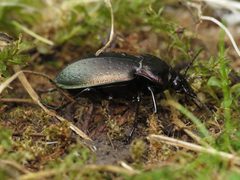
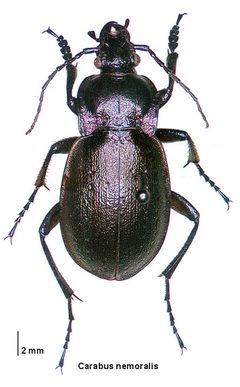
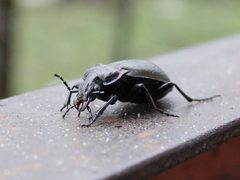
Carabus nemoralis is a large ground beetle native to central and northern Europe, Iceland, and parts of Asia. It has been introduced to North America and New Zealand, where it is actively expanding its range. measure 20–25 mm and are active year-round. The is recognized as a beneficial in agricultural systems, with documented effectiveness against slugs and other pests.
Pronunciation
How to pronounce Carabus nemoralis: //kəˈrɑːbəs nɛˈmɔrɪlɪs//
These audio files are automatically generated. While they are not always 100% accurate, they are a good starting point.
Identification
are identified by their large size (20–25 mm), metallic bronze , and robust ground beetle . They may be confused with other large Carabus , but the specific metallic bronze coloration and documented range help distinguish C. nemoralis. Larvae are elongate and active , superficially resembling rove beetles (Staphylinidae) but with different capsule structure and form.
Images
Habitat
Found in a wide variety of including forests, fields, gardens, and agricultural areas. In Great Britain, it occupies diverse habitats. The shows adaptability to human-modified landscapes and has been documented in dry-mesic deciduous forests, open woodlands, and agricultural fields.
Distribution
Native to central and northern Europe, Iceland, and parts of Asia (including Kazakhstan, Kyrgyzstan, and Russia). Introduced and established in North America (Canada, USA), where it is actively expanding its range, and in New Zealand. C. n. lamadridae occurs in Spain, and C. n. prasinotinctus in France and Spain.
Seasonality
are active year-round. Breeding occurs in spring, with hatching in autumn of the same year. Larvae are present during early summer months.
Diet
and larvae are predatory. Adults feed on slugs (including the agricultural pest Deroceras reticulatum), slug , and annelids. Larvae are voracious hunters of annelids and slugs.
Life Cycle
One breeding period per year in spring. hatch in autumn. Larvae develop through the summer, preying on soft-bodied . are long-lived and active across all seasons.
Behavior
are ground-dwelling and nocturnally active . When threatened, some regurgitate a foul-smelling brownish-red liquid as a chemical defense. Specimens can also eject fecal matter at high speed when handled or disturbed. Both larvae and adults are active hunters that pursue prey rather than ambushing it.
Ecological Role
of soft-bodied , particularly slugs and earthworms. Functions as a natural agent in agricultural and garden . Its introduction to new regions has been studied for potential biocontrol applications.
Human Relevance
Recognized as a beneficial insect in agriculture due to on slug pests. Has been tested as a biocontrol agent for large- farming operations. The is not considered a pest and does not damage crops or stored products.
Similar Taxa
- Carabus granulatusSimilar large size and ground beetle , but C. granulatus has elytral and different preferences, typically associated with wetter environments.
- Other Carabus speciesMany Carabus overlap in size and general appearance; accurate identification requires examination of elytral microsculpture, pronotal shape, and male genitalia.
More Details
Defense Mechanisms
Two distinct chemical defenses have been documented: regurgitation of foul-smelling liquid and high-speed ejection of fecal matter. These are induced by handling or attempts.
Biocontrol Potential
Research programs have evaluated C. nemoralis for large- agricultural biocontrol, capitalizing on its established effectiveness against Deroceras reticulatum and other slug pests.
Sources and further reading
- BugGuide
- Wikipedia
- GBIF taxonomy match
- iNaturalist taxon
- NCBI Taxonomy
- Catalogue of Life
- Thinking small: how bugs are getting bulldozed by planning - Buglife Blog - Buglife
- Plantae | Beetles In The Bush | Page 7
- Hughes Mountain redux | Beetles In The Bush
- Arthropoda | Beetles In The Bush | Page 8
- Monitoring Ecological Change with Northern Beetles
- What do insects do in winter, Part 2? Tolerating the big chill: Banded woolly bears, Pyrrharctia isabella, field crickets, Gryllus spp., baldfaced hornets, Dolichovespula maculata, and others — Bug of the Week