
Carabus granulatus
Linnaeus, 1758
Granulated Ground Beetle
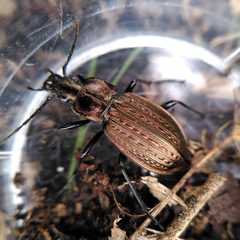
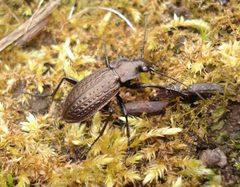
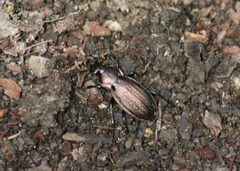
Carabus granulatus is a small, winged ground beetle native to the Palearctic, ranging from Ireland to the Russian Far East, with introduced in North America. measure 14–20 mm and exhibit metallic greenish-bronze, green, or occasionally black coloration with distinctive granulated . Unlike most Carabus , it has retained functional ability, though it primarily remains ground-dwelling. The species occupies diverse including forests, fields, prairies, taiga, river margins, fens, lakeshores, and upland peat, occasionally occurring in gardens.
Pronunciation
How to pronounce Carabus granulatus: /ˈka.ra.bus ɡræˈnjuː.ləˌtus/
These audio files are automatically generated. While they are not always 100% accurate, they are a good starting point.
Identification
Small Carabus (14–20 mm) with elongated, flattened body and enlarged . and legs black; surface shiny, predominantly greenish-bronze, green, or occasionally black. subparallel with distinctive longitudinal grooves containing , creating a 'chain link' pattern. Winged, unlike many ; mountain may be short-winged.
Images
Habitat
Fields, prairies, taiga, and forests; also river margins, fens, lakeshores, upland peat, and occasionally gardens. In Western Transbaikalia, floodplain meadows provide optimal conditions compared to steppe and saline meadows.
Distribution
Native to the Palearctic: Europe (widespread), Ireland eastward through Russia to the Russian Far East and Japan. Introduced to North America (USA and Canada). distributed across specific regions including Italy, Georgia, Azerbaijan, Kazakhstan, Kyrgyzstan, China, Mongolia, and Japan.
Seasonality
activity pattern. hide under tree trunks or stones during daylight. occurs in communal within tree stumps from autumn through spring. Seasonal activity extends through warm, long autumns.
Diet
Predatory: feeds on insects, worms, and snails.
Life Cycle
One-year spring–early summer with hibernation of last-instar larvae. Females lay approximately 40 . Larvae undergo three before pupating in soil. emerge in autumn. In Western Transbaikalia, warm autumns can extend seasonal activity and enable life cycle patterns characteristic of the Russian Far East and Japan.
Behavior
forager that remains primarily on the ground despite capability. hide under tree trunks or stones during daytime. Communal in tree stumps from autumn to spring. One of few Carabus that has not completely lost flight ability, though flight is rarely used.
Ecological Role
controlling of insects, worms, and snails. Serves as potential paratenic for the parasitic Haemonchus contortus, a of domestic and wild ruminants. Morphometric variation across indicates potential utility as bioindicator for environmental monitoring.
Human Relevance
Accidentally introduced to North America, where established exist. Occasionally found in gardens. Subject of ecological research on cold hardiness, morphometric variation, and climate change responses. Potential role in transmission dynamics of livestock requires further investigation.
Similar Taxa
- Carabus glabratusSympatric ground beetle with potentially overlapping use in northern taiga; distinguished by morphological and differences
- Other Carabus speciesMost are flightless and typically larger with more convex bodies; C. granulatus distinguished by retained wings, smaller size, and granulated
Sources and further reading
- BugGuide
- Wikipedia
- GBIF taxonomy match
- iNaturalist taxon
- NCBI Taxonomy
- Catalogue of Life
- What do insects do in winter, Part 2? Tolerating the big chill: Banded woolly bears, Pyrrharctia isabella, field crickets, Gryllus spp., baldfaced hornets, Dolichovespula maculata, and others — Bug of the Week
- Buprestidae | Beetles In The Bush | Page 8
- Thinking small: how bugs are getting bulldozed by planning - Buglife Blog - Buglife
- Monitoring Ecological Change with Northern Beetles
- Life cycle of Carabus granulatus Linnaeus 1758 (Coleoptera, Carabidae) in Western Transbaikalia
- LANDSCAPE-DEPENDENT VARIABILITY OF MORPHOMETRIC TRAITS IN CARABUS GRANULATUS L., 1758 (COLEOPTERA, CARABIDAE)
- Spatial Variation in Morphometric Traits of Carabus Granulatus L., 1758 (Coleoptera: Carabidae) at A Small Scale
- Seasonal aspects of the life cycles of Carabus granulatus and C. glabratus (coleoptera, carabidae) in the northern taiga
- Geographic Gradients in a Functional Trait: Variation in Body Size of the Ground Beetle Carabus granulatus Linnaeus (Coleoptera, Carabidae)
- First molecular identification of Haemonchus contortus ( Nematoda: Trichostrongylidae ), a blood‐sucking gastric nematode of artiodactyles, in the ground beetle Carabus granulatus ( Coleoptera: Carabidae )