
Broscus cephalotes
Linnaeus, 1758
coastal ground beetle
Broscus cephalotes is a , flightless ground beetle in the Carabidae. It is native to coastal regions of temperate Europe and western Siberia, and was introduced to eastern Canada around 1975, subsequently spreading into the United States. The is recognized as beneficial in agricultural contexts due to its predatory habits.
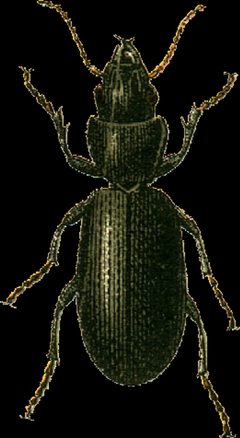
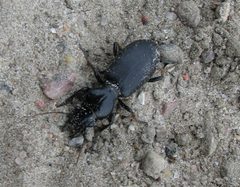
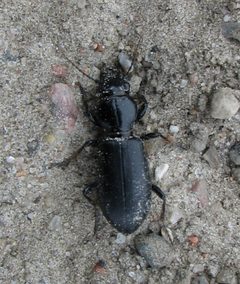
Pronunciation
How to pronounce Broscus cephalotes: //ˈbrɒs.kəs ˌsɛf.əˈloʊtiːz//
These audio files are automatically generated. While they are not always 100% accurate, they are a good starting point.
Identification
Distinguished from other Carabidae by its flattened, flightless body form and asymmetric . The combination of large size (16–23 mm), dull non-metallic black coloration, and coastal helps separate it from similar ground beetles. The left mandible being longer and wider than the right is a distinctive feature.
Images
Appearance
Dull black coloration without metallic sheen. Body length 16–23 mm. Body dorsoventrally flattened, an for hiding in crevices. Flightless, with reduced or absent hind wings. Asymmetric : blunt, curved to rounded point, twice as long as wide; left mandible slightly longer and wider than right. Mandibles function as multi-purpose tools for digging and feeding.
Habitat
Primarily coastal vegetated dunes, with preference for sparsely vegetated areas. Also found inland, though less commonly. Requires loose, dry sand for burrowing. Hides under stones, logs, and bark during daylight hours.
Distribution
Native range: temperate western and central Europe through western Siberia. Introduced range: eastern Canada (first recorded 1978 in Nova Scotia), with subsequent spread south and west into the United States. In North America, currently confined to the eastern seaboard and less common than in Europe.
Seasonality
active spring through early autumn. Breeding occurs in early autumn (late summer to early September). Adults emerge from burrows in late spring and early summer, with most completed by early July. Most adults do not survive winter; larvae develop during winter months.
Diet
. Prey includes ants, woodlice, wolf spiders, aphids, caterpillars, dipterans, mites, bibionid flies, other beetles, Lepidoptera, and Heteroptera. Laboratory studies show preference for woodlice and ants. Also consumes plant material. No evidence of . Larvae are fluid feeders with more restricted diet than adults.
Life Cycle
deposited deep in sandy soil in late summer and early autumn. No parental care. Larvae develop in subterranean tunnels during winter and early spring. emerge late spring to early summer. Most individuals complete development in one year and reproduce once before dying; some may follow a two-year schedule. Most adults do not survive winter.
Behavior
, hiding in burrows under logs and stones during daylight. Occasionally seen moving between hiding places during day. Constructs and maintains tunnels using as shovels to move sand and debris. Detects prey through tactile and olfactory cues; olfactory responses are non-specific. Captures prey at burrow entrance, holds with forelegs, and tears with mandibles. Pre-oral digestion with enzymatic fluid. Fighting between individuals observed under artificial light, purpose undetermined. May rest in groups, though this appears opportunistic rather than social.
Ecological Role
of various including crop pests. Prey includes aphids, slugs, dipteran , and other agricultural pests. Serves as significant food source for birds (corvids, raptors, farmland birds), small mammals (hedgehogs, shrews, mice), amphibians, and reptiles. Can constitute up to 20% of mammalian diet in June when beetles are most abundant.
Human Relevance
Recognized as beneficial to agriculture since early 19th century. on crop pests (aphids, slugs, dipteran ) supports natural pest control. loss from heathland reduction and development in Britain has raised conservation concerns. Sandy roadsides may serve as habitat corridors linking fragmented . Increasingly considered in crop planning and strategies.
Similar Taxa
- Other CarabidaeB. cephalotes is flightless and more flattened than many , with distinctive asymmetric and coastal specialization
- Other Broscus speciesRequires examination of asymmetry and body proportions; B. cephalotes is among the larger in the
More Details
Digestive tract contents
Sand frequently found in digestive tract, possibly aiding mechanical breakdown of prey. Function not definitively established.
Laboratory longevity
Some individuals maintained in laboratory conditions survive longer than one year, though field longevity is typically shorter.
Temperature effects on reproduction
In laboratory settings, higher temperatures correlate with extended reproductive periods and increased production. Field validation lacking.
Sources and further reading
- BugGuide
- Wikipedia
- GBIF taxonomy match
- iNaturalist taxon
- NCBI Taxonomy
- ESA Entomology Games Are Both Educational and Entertaining | Bug Squad
- Meloidae Holdings | Entomology Research Museum
- Prime Time for Learning | Bug Squad
- Atta cephalotes ant - Entomology Today
- leafcutter ant, Atta cephalotes - Entomology Today
- Cephalotes-ants - Entomology Today