
Brachinus pallidus
Erwin, 1965
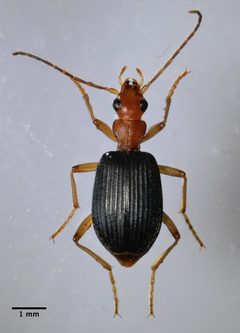
Brachinus pallidus is a bombardier beetle in the Carabidae, first described by Erwin in 1965. Like other members of the Brachinus, it possesses the remarkable chemical defense system for which bombardier beetles are famous: paired glands that combine hydroquinones and hydrogen peroxide to produce a hot, noxious spray of benzoquinones when threatened. The is known from California and represents part of the diverse North American fauna of this chemically defended ground beetle genus.
Pronunciation
How to pronounce Brachinus pallidus: /brəˈkaɪnəs ˈpælɪdəs/
These audio files are automatically generated. While they are not always 100% accurate, they are a good starting point.
Identification
Brachinus pallidus can be distinguished from other Brachinus by its relatively pale coloration, as suggested by the specific epithet 'pallidus.' Within the , species identification typically requires examination of male genitalia and subtle differences in body proportions, punctation, and coloration. All Brachinus species share the characteristic bombardier beetle : streamlined body form, relatively long legs adapted for running, and the abdominal defensive gland system visible as paired lateral glands on the .
Images
Distribution
Known from California, USA. GBIF records indicate presence in the United States and North America broadly.
Behavior
Brachinus pallidus exhibits the characteristic bombardier beetle defensive shared by all members of the : when threatened, it discharges a hot, noxious chemical spray from abdominal glands. This spray contains benzoquinones and reaches temperatures near 100°C due to the exothermic reaction between hydroquinones and hydrogen peroxide catalyzed by . The can aim this discharge with considerable in response to tactile stimuli.
Ecological Role
As a ground beetle, Brachinus pallidus likely functions as a in soil and ground surface . Its chemical defense system may also influence dynamics by affecting predator-prey interactions and potentially serving as a model for by other insects.
Similar Taxa
- Brachinus (other species)Other bombardier beetles in the same share the chemical defense system and general body form, requiring careful examination for -level identification.
- Pheropsophus verticalisAnother bombardier beetle that has been suggested as a potential model for mimicry by insects with similar coloration and pattern.
Sources and further reading
- BugGuide
- GBIF taxonomy match
- iNaturalist taxon
- NCBI Taxonomy
- Don't Bet Your Hedges: IPM Guide Outlines Ficus Whitefly Management
- Bug Eric: Red-shouldered Bug
- Araneae | Beetles In The Bush | Page 5
- My, what busy palps you have! | Beetles In The Bush
- Kentucky | Beetles In The Bush
- Bombardier Beetles (Coleoptera, Carabidae) of North America: Part II. Biology and Behavior of Brachinus pallidus Erwin in California